
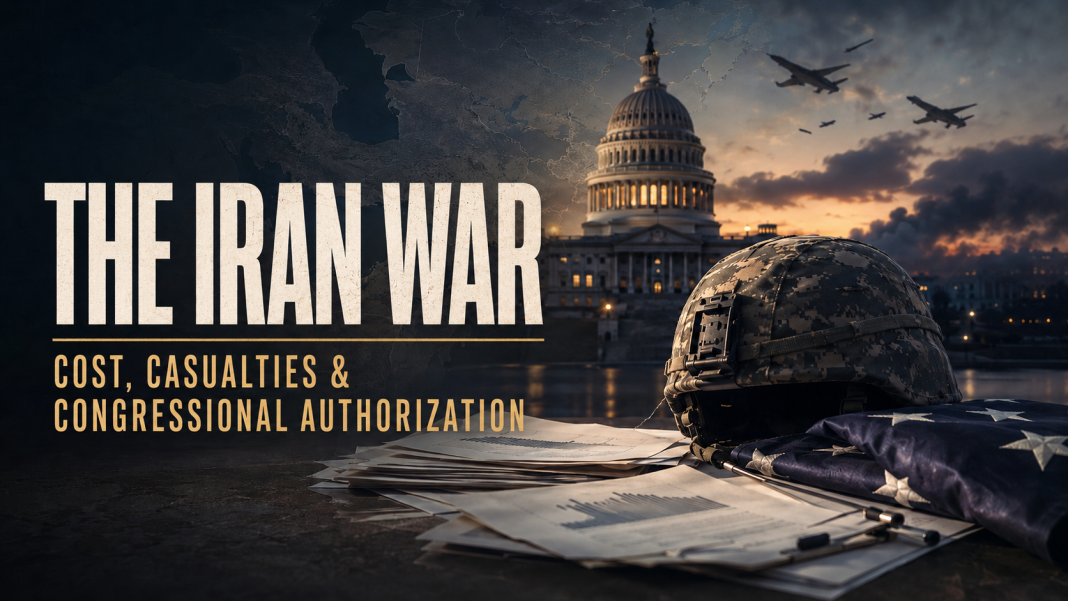

The expanding conflict has cost American taxpayers at least $37.5 billion, killed thousands across the Middle East and reopened one of Washington’s oldest disputes: Who has the authority to take the United States to war?
The United States’ war with Iran has entered a politically and militarily uncertain phase. What began on February 28, 2026, as a joint American-Israeli campaign against Iranian nuclear, missile and military facilities has developed into a prolonged regional conflict involving airstrikes, missile attacks, disrupted shipping, American casualties and mounting pressure on Congress to decide whether the fighting should continue.
The war’s direct cost to American taxpayers has reached at least $37.5 billion, according to Defense Secretary Pete Hegseth. The administration has requested tens of billions of dollars in additional funding to replace munitions, support deployed forces and continue military operations. At least 18 American service members have died, more than 500 have reportedly been wounded, and thousands of people have been killed across Iran, Lebanon, Iraq, Israel and neighboring countries.
Beyond the battlefield, the conflict has disrupted oil shipments through the Strait of Hormuz, pushed gasoline prices higher, increased federal borrowing and raised questions about the readiness of America’s military stockpiles.
The most consequential issue, however, may be constitutional. Congress has not declared war against Iran or enacted a specific Authorization for Use of Military Force, commonly called an AUMF. President Donald Trump maintains that he acted under his authority as commander in chief and chief executive. Lawmakers from both parties argue that a military campaign of this duration and scale requires explicit approval from Congress.
The result is a conflict being fought simultaneously on three fronts: on the ground and in the skies of the Middle East, within the federal budget and between the legislative and executive branches of the United States government.
How the war began
President Trump ordered American forces to begin major military operations against Iran on February 28. The campaign, called Operation Epic Fury, was launched in coordination with Israel and initially focused on Iran’s nuclear infrastructure, ballistic missiles, missile-production facilities, air defenses, naval forces and command-and-control systems.
The administration said the operation was necessary to prevent Iran from obtaining a nuclear weapon, protect American forces and allies, and preserve international navigation through the Strait of Hormuz.
In his March 2 report to Congress, President Trump stated that the strikes were intended to protect U.S. forces, defend the American homeland, support regional allies and ensure the free flow of maritime commerce. The president acknowledged that it was impossible at that time to determine the full scope or duration of the operation. He based his action on his constitutional authority as commander in chief and chief executive—not on a declaration of war or a newly enacted congressional authorization. White House War Powers report published by the Government Publishing Office
The administration originally presented the mission as a focused operation to eliminate Iran’s nuclear and offensive military capabilities. As the conflict continued, its stated objectives expanded to include protecting commercial shipping, responding to attacks on American personnel, weakening Iran’s regional military network and restoring navigation through the Strait of Hormuz.
That evolution has concerned lawmakers who say the United States entered the conflict without a clearly defined political objective, timeline or condition for ending military operations.
The direct cost to American taxpayers
During a July 21 Senate Appropriations Committee hearing, Hegseth estimated that the war had cost the United States $37.5 billion. The figure represents expenses already incurred and does not include all future replacement, medical, disability, interest or veterans’ costs.
The administration has sought approximately $67 billion in additional Iran-related defense funding as part of a broader congressional budget package. The requested money would help finance continuing operations, replace missiles and other munitions, maintain deployed forces, repair or replace damaged equipment, and strengthen American offensive and defensive capabilities. Associated Press report on the Pentagon’s cost estimate and funding request
If Congress approves the full request, the amount committed to the conflict could quickly rise above $100 billion. That still would not represent its final cost.
Wars generate financial obligations that continue long after active combat ends. These include medical treatment for wounded personnel, disability compensation, survivor benefits, mental-health services, equipment replacement and interest on money borrowed to finance military operations. The experience of Iraq and Afghanistan demonstrated that the long-term cost of caring for veterans and paying interest can substantially exceed the initial operating expenses.
The $37.5 billion estimate should therefore be understood as an early accounting—not a final price.
The speed at which money is being spent has also raised concerns about American weapons inventories. Modern air and missile defense systems rely on expensive interceptors that can cost millions of dollars each. Replacing precision-guided weapons requires time, specialized production facilities and reliable supply chains. Congress must consider whether continued operations against Iran could reduce the weapons available for other possible conflicts or security commitments.
Another issue is whether Congress will pay for the war by reducing other spending, raising revenue or adding to the federal deficit. The current proposals generally do not contain enough spending reductions or new revenue to offset the military expense. As a result, much of the cost could be financed through additional federal borrowing.
The broader economic cost
The financial impact extends beyond the Pentagon.
The Strait of Hormuz normally carries approximately one-fifth of the world’s oil and liquefied natural-gas trade. Fighting, mining, attacks on commercial ships and competing navigation routes have reduced traffic through the waterway and created uncertainty for energy markets. Reuters report on the Strait of Hormuz and regional shipping
Oil-price increases have translated into higher gasoline, diesel and transportation costs. By late July, the average U.S. gasoline price had climbed to approximately $4.10 per gallon. Higher energy expenses can spread through the economy because farms, manufacturers, airlines, trucking companies and retailers all depend on fuel.
Consumer confidence declined in July as Americans faced higher gasoline prices and continuing concerns about food, housing and insurance costs. Inflation, which had been moderating before the war, increased as energy costs rose. Associated Press report on consumer confidence, inflation and gasoline prices
The conflict has also affected shipping insurance, aviation routes, fertilizer supplies and global supply chains. These secondary costs do not appear in the Pentagon’s budget, but they are paid by businesses and consumers through higher prices.
The full economic cost of the war must therefore include both federal military spending and the indirect effect on household expenses, commercial activity and economic growth.
American military casualties
As of July 28, 18 U.S. service members had died in connection with the Iran conflict. More than 500 were reportedly wounded, although the exact total has become a matter of dispute.
Fourteen American troops died during the initial phase of fighting. Four additional service members were killed after hostilities resumed in July. Three died after an Iranian missile struck their barracks at Muwaffaq Salti Air Base in Jordan. A fourth died in Iraq during the controlled detonation of an Iranian attack drone. Reuters report on the 18 American deaths and dignified transfer at Dover Air Force Base
The Pentagon’s public database temporarily listed 14 deaths and 420 wounded after previously acknowledging the later casualties. The department created a separate “Overseas Operations” category for casualties occurring after July 7, when renewed fighting followed an earlier ceasefire.
President Trump has publicly acknowledged that the conflict claimed 18 American lives. An American official also told The Associated Press that the actual number of wounded troops had grown to well over 500. Associated Press examination of the Pentagon’s casualty accounting
The disagreement is more than an accounting dispute. Accurate casualty reporting affects public trust, congressional oversight and the historical record. It can also affect how military service is documented and how veterans establish eligibility for healthcare or disability benefits connected to combat exposure.
Congress has a responsibility to demand a consistent public accounting that includes all personnel killed or wounded as a result of Iranian attacks, American combat missions and related military operations.
Iranian and regional casualties
The human cost within Iran has been far greater.
By April 10, Iranian officials reported that more than 3,000 people had been killed. The U.S.-based Human Rights Activists News Agency reported 3,636 deaths, including 1,701 civilians and at least 254 children. Reuters noted that it could not independently verify the totals. Reuters casualty assessment from the first phase of the war
Renewed American strikes during July reportedly killed at least 50 additional people and wounded more than 500, according to Iran’s Health Ministry. Those figures cover only part of the renewed campaign and cannot be treated as a complete updated total. Reuters report on July strikes and casualties
The conflict has also spread beyond Iran.
By April, Lebanese authorities reported at least 1,830 deaths from Israeli strikes after Hezbollah entered the fighting. Iraqi authorities reported at least 117 deaths involving civilians, security forces and armed groups. Iranian missile attacks had killed civilians and military personnel in Israel, the United Arab Emirates, Kuwait, Syria and the West Bank.
These numbers come from governments, military organizations and independent monitoring groups using different definitions and reporting methods. Some include combatants and civilians together. Others cover only limited periods. Casualty totals should consequently be presented as reported figures rather than precise, independently confirmed counts.
Even with those limitations, the available evidence establishes that thousands of people have died and many more have been injured, displaced or deprived of essential services.
Did Congress authorize the war?
The Constitution divides responsibility for war between Congress and the president.
Article I gives Congress the authority to declare war, raise and support armies, provide for the Navy, regulate the armed forces and control federal spending. Article II makes the president commander in chief. The president directs military operations, but the extent to which that authority permits the initiation of a major, sustained war without Congress remains disputed. U.S. House historical explanation of constitutional war powers
Congress attempted to clarify this division after the Vietnam War by enacting the War Powers Resolution of 1973. The law requires the president to consult Congress when possible, notify lawmakers within 48 hours after introducing forces into hostilities and end unauthorized military involvement after 60 days, with a limited period for withdrawal, unless Congress authorizes the operation or extends the deadline. War Powers Resolution, 50 U.S.C. Chapter 33
President Trump submitted a notification to Congress after the February 28 strikes. Reporting an operation, however, is not the same as obtaining authorization for it.
Congress has neither declared war on Iran nor passed a specific AUMF for the 2026 campaign. The administration contends that the April ceasefire ended the original hostilities and therefore stopped or reset the War Powers Resolution’s 60-day clock. Critics respond that continued military actions, blockades and renewed strikes were part of the same conflict and cannot lawfully be divided into separate operations to avoid the statutory deadline.
The deadline calculated from the February 28 beginning of hostilities fell around May 1. By then, Congress had not approved a new authorization.
Congress votes to end unauthorized hostilities
In June, both the House and Senate passed a War Powers concurrent resolution directing the president to withdraw U.S. forces from unauthorized hostilities with Iran. The Senate approved the measure 50-48. It was the first time since passage of the 1973 law that an Iran-related withdrawal resolution had cleared both chambers in this manner. Reuters explanation of the congressional War Powers action
The resolution demonstrated meaningful bipartisan opposition to continuing the conflict without an AUMF. Its legal effect, however, is contested because a concurrent resolution does not go to the president for signature and does not ordinarily carry the force of law.
Congress possesses stronger options. It can pass a binding joint resolution requiring withdrawal, deny or restrict funding, enact a narrowly defined AUMF, impose reporting requirements or refuse the administration’s supplemental military request.
Appropriating money for military operations does not necessarily constitute legal authorization for war. The War Powers Resolution states that authority should not be inferred from general defense appropriations unless the legislation specifically says that it is intended to authorize hostilities.
That distinction will become increasingly important as lawmakers consider additional Iran funding. Members could support pay, protection and equipment for deployed troops while still opposing an open-ended military commitment. Conversely, approving unrestricted war funding without requiring an authorization vote could weaken Congress’s claim that the conflict is proceeding without its consent.
What an authorization should address
If Congress decides that military operations should continue, an AUMF should provide more than a general endorsement. It should define:
- The specific military and political objectives of the operation;
- The countries, armed groups and geographic areas covered;
- Whether ground combat forces may be deployed;
- Which actions constitute success;
- How often the administration must report costs and casualties;
- What protections are required for civilians;
- How Congress will oversee weapons use and replacement;
- When the authority expires; and
- What conditions would allow the president to extend or expand the mission.
A carefully written sunset provision would force Congress to reconsider the authorization after a fixed period. Without one, a temporary military operation could become a long-term commitment under language written for a different set of circumstances.
If Congress concludes that the war is not necessary or lacks an achievable objective, it should establish a responsible withdrawal schedule and specify which defensive actions remain authorized to protect American personnel.
The decision Congress cannot avoid
The Iran war is no longer a short military strike with a limited financial or human cost. It is a sustained regional conflict that has killed American service members, taken thousands of lives in the Middle East, disrupted global energy markets and required tens of billions of dollars in federal spending.
The administration argues that military pressure is necessary to prevent a nuclear-armed Iran, protect American forces and restore safe navigation through the Strait of Hormuz. Critics argue that the mission has expanded without a clear endpoint and that the president cannot continue a major war indefinitely without congressional authorization.
Both concerns deserve a direct public debate.
Congress’s constitutional role is not limited to receiving briefings or approving money after military operations have begun. Lawmakers must decide whether the objectives justify the cost, whether the strategy can achieve those objectives, what limits should apply and how the war will end.
That decision should be made through recorded votes on authorization and funding—not through silence, ambiguous appropriations or shifting definitions of when one phase of hostilities ends and another begins.
For American families, military personnel and civilians across the Middle East, the questions are immediate: How much more will the war cost? How many additional lives will be lost? What outcome is the United States seeking? And who, under the Constitution, has authorized the country to continue fighting?
As of July 28, 2026, those questions remain unanswered.





Leave a Reply