
Election Integrity and Voter Identification: Congress Debates Who Must Prove Eligibility—and How
The SAVE America Act would establish national identification and citizenship-document requirements for federal elections. Supporters call the legislation a commonsense safeguard; opponents warn that eligible citizens could be prevented from registering or voting.
By USCongress.us Staff
August 23, 2026
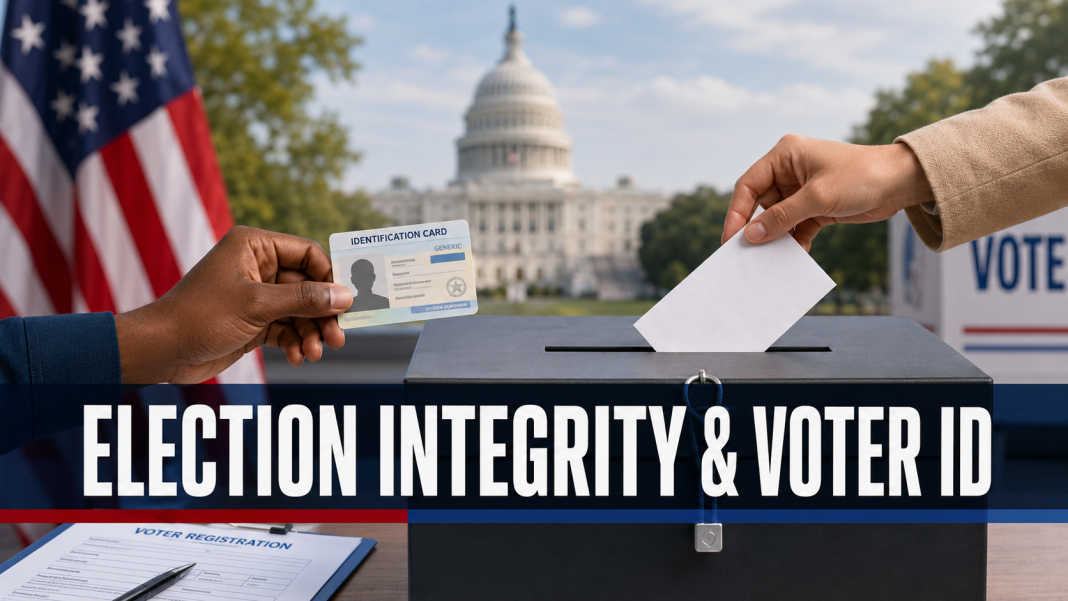
Election integrity has become one of the most consequential—and most disputed—issues before Congress as the nation approaches the November 2026 midterm elections. At the center of the debate is the SAVE America Act, legislation that would require documentary proof of United States citizenship when registering to vote in federal elections and government-issued photo identification when casting a ballot.
The fundamental principles are not disputed. Only eligible American citizens may vote in federal elections, every lawful vote should be counted and election procedures must be secure enough to earn public confidence. The disagreement concerns how the government should enforce those principles without preventing qualified citizens from participating.
Supporters of stricter identification laws contend that relying principally on an applicant’s signed citizenship attestation leaves an avoidable weakness in voter registration. They argue that identification is routinely required for other important transactions and that uniform federal standards would deter illegal voting, improve voter rolls and increase confidence in election results.
Opponents respond that noncitizen voting and in-person voter impersonation are already illegal and relatively rare. They argue that requiring passports, certified birth certificates or other citizenship records could burden millions of eligible citizens—especially married women whose legal names have changed, older Americans, rural residents, low-income voters, students and people with disabilities.
The debate is therefore not simply “security versus access.” It is a dispute over which safeguards are necessary, which burdens are reasonable and whether the federal government or the states should make those decisions.
What the SAVE America Act would do
The Safeguard American Voter Eligibility America Act—generally called the SAVE America Act—passed the House of Representatives on February 11, 2026, by a vote of 218–213. Representative Henry Cuellar of Texas was the only Democrat to join Republicans in supporting the measure. House Administration Committee
The legislation contains two principal requirements:
- An applicant registering to vote in a federal election would have to provide documentary proof of United States citizenship.
- A voter would have to present an accepted form of government-issued photo identification before casting a regular ballot in a federal election.
Acceptable citizenship documentation could include a valid U.S. passport, a certified birth certificate accompanied by appropriate identification, a certificate of naturalization, a certificate of citizenship or certain other records demonstrating citizenship.
A conventional driver’s license would not necessarily prove citizenship because states may issue licenses to noncitizens. Even a REAL ID generally verifies identity and lawful presence but does not always establish U.S. citizenship. Consequently, some applicants could need both photo identification and a separate citizenship document.
The legislation would also direct states to verify voter-registration information using federal data, remove identified noncitizens from federal voter rolls and adopt procedures for applicants who cannot immediately produce the required documentation.
Supporters say the bill creates a dependable verification system. Critics say it transfers the burden of locating and presenting government records from election agencies to individual citizens.
The nonpartisan Bipartisan Policy Center estimates that approximately 12% of registered voters may lack ready access to documents that would satisfy the proposed citizenship requirement. It also warns that local election officials and motor-vehicle agencies may not have the staffing or training required to authenticate citizenship documents. Bipartisan Policy Center
Citizenship is already required
Federal law already prohibits noncitizens from voting in federal elections. A person who knowingly violates that prohibition can face criminal prosecution, fines, imprisonment and immigration consequences. Applicants using the federal voter-registration form must affirm, under penalty of perjury, that they are U.S. citizens.
The Justice Department has prosecuted individual cases. In June 2026, for example, federal prosecutors in Florida announced that three noncitizens had pleaded guilty in separate cases involving illegal voting or related false statements. Other 2026 prosecutions or charges have been announced in Alabama, New Jersey, South Carolina and Hawaii. U.S. Department of Justice
These cases demonstrate that illegal noncitizen voting can occur. They do not, standing alone, establish its overall frequency or prove that it has changed the outcome of a federal election.
That distinction is important. Supporters argue that even infrequent illegal votes are unacceptable and that prevention is more responsible than prosecution after an election. Opponents maintain that Congress should measure the scope of a problem before imposing a national documentation system that could affect tens of millions of registrations.
A well-grounded election policy must recognize both realities: illegal voting is not imaginary, but documented individual cases are not evidence of widespread fraud.
The case for a national voter-identification requirement
Supporters of the SAVE America Act argue that voter identification is a basic administrative safeguard rather than a partisan restriction.
Thirty-six states request or require voters to show some form of identification at the polls. State rules vary considerably: some require photo identification, while others accept non-photo documents such as bank statements, utility bills or paychecks. Fourteen states and the District of Columbia use other methods, most commonly comparing a voter’s signature or personal information with registration records. National Conference of State Legislatures
Only 10 states, however, fall within the National Conference of State Legislatures’ “strict photo ID” category. The SAVE America Act would therefore establish a national standard more restrictive than the rules currently used in most states. NCSL analysis of the proposed legislation
Supporters offer several arguments for that approach.
First, identification can deter voter impersonation. Although confirmed cases of in-person impersonation are uncommon, advocates argue that the difficulty of detection may understate the risk.
Second, proof of citizenship could prevent an ineligible person from entering the voter system in the first place. An accurate registration list, they argue, is preferable to removing an illegal registration after a ballot has been cast.
Third, national standards could reduce confusion. Federal elections currently operate under different identification rules depending on the state. A uniform rule would establish the same minimum requirements for congressional and presidential elections.
Fourth, supporters believe voter ID would improve confidence. Even when fraud is rare, public suspicion can weaken acceptance of election results. A visible identification system, proponents argue, may assure citizens that each voter’s identity and eligibility have been verified.
The Supreme Court recognized legitimate state interests in deterring fraud, modernizing election procedures and protecting public confidence when it upheld Indiana’s photo-identification law in Crawford v. Marion County Election Board in 2008. The decision did not declare every possible voter-ID requirement constitutional; courts must still consider the burden imposed by a particular law.
The case against the legislation
Opponents distinguish between broadly defined voter identification and the specific requirements contained in the SAVE America Act.
A voter-ID system can accept many documents, provide free identification, allow a voter to sign an affidavit or offer a reasonable process for curing an identification problem. By contrast, opponents argue, the SAVE America Act would require a narrower group of documents and impose new obligations at registration as well as voting.
The principal concern is documentary proof of citizenship.
Many citizens do not have a valid passport. A person born in the United States may not possess a certified birth certificate or may have difficulty obtaining one from another state. A birth certificate also may display a name that no longer matches the voter’s current identification because of marriage, divorce, adoption or another legal change.
Native American voters may face complications involving tribal documents, remote government offices or nontraditional addresses. Rural voters may live far from an election office. Older citizens may have been born when government recordkeeping was less standardized. Naturalized citizens could be required to produce records that native-born citizens have never previously needed to present for voting.
Mail and online registration would also be affected. If an applicant must present citizenship documents in person, the practical value of remote registration could be substantially reduced. That would represent a major change from the National Voter Registration Act’s effort to make registration more widely available through motor-vehicle offices, mail forms and public agencies.
Critics also warn about the consequences for election workers. The SAVE America Act would establish penalties and potential legal exposure when officials register an applicant who has not provided sufficient documentation. Opponents fear this could encourage officials to reject uncertain applications rather than risk prosecution or litigation.
The impact on turnout is contested. A Government Accountability Office review found mixed results among academic studies: five studies found no statistically significant effect from identification laws, four found decreased turnout and one found increased turnout. The studies examined different laws, elections and populations, making a universal conclusion difficult. U.S. Government Accountability Office
The lawmakers promoting stricter requirements
Representative Chip Roy, Republican of Texas, and Senator Mike Lee, Republican of Utah, have been leading architects and promoters of the SAVE America Act.
Roy has argued that citizenship verification is essential to maintaining the exclusivity of the American franchise. Lee has promoted federal action in the Senate and criticized procedural rules that could allow a minority of senators to block the measure.
Representative Bryan Steil, Republican of Wisconsin and chairman of the Committee on House Administration, managed the legislation in the House. Steil describes proof of citizenship and photo identification as commonsense measures that would restore confidence while keeping voting accessible.
“The SAVE America Act is commonsense,” Steil told the House Rules Committee. “It requires photo ID to vote” and requires states “to confirm U.S. citizenship when someone first registers to vote.” House Administration Committee
House Speaker Mike Johnson of Louisiana has also promoted election-integrity legislation, while President Donald Trump has urged Congress to adopt photo identification, proof-of-citizenship rules and tighter restrictions on mail voting.
Representative Cuellar’s vote gave the House bill limited bipartisan support. Cuellar said Texas already maintains strong election-security standards and argued that Americans should have confidence that only eligible citizens participate.
In July, House Republicans pursued another approach by including election-identification provisions in budget and stock-trading legislation. A reconciliation proposal would use federal financial incentives rather than directly requiring every state to adopt the national standards. States meeting the citizenship and photo-ID requirements would become eligible for funding.
That strategy could improve the proposal’s Senate prospects because budget-reconciliation legislation can sometimes pass with a simple majority. However, election-law provisions may be challenged under Senate rules if their policy effects outweigh their budgetary impact.
The lawmakers opposing the current proposal
Senate Minority Leader Chuck Schumer of New York has been one of the most prominent opponents of the SAVE America Act as written. Schumer has described its requirements as excessively restrictive, although he has indicated that Democrats may be willing to discuss more flexible identification standards.
Representative Joe Morelle of New York, the ranking Democrat on the House Administration Committee, has argued that the legislation could disenfranchise lawful voters and impose substantial administrative burdens on state and local officials.
Other Democratic lawmakers maintain that Republicans have combined a broadly popular concept—voter identification—with a much narrower documentary system that many citizens could find difficult to satisfy.
Voting-rights organizations, including the League of Women Voters, Campaign Legal Center and Brennan Center for Justice, oppose the measure. Their analyses emphasize the effect on registration, name discrepancies, access to documents and criminal exposure for election officials. Campaign Legal Center
Not every opponent rejects all identification requirements. Some Democrats have supported alternatives that would accept a broader range of documents, provide free federal identification, allow sworn affidavits or establish a government-run verification process that does not require voters to locate citizenship papers.
That distinction could become the basis for a compromise.
Congress and the states share election authority
The Constitution gives states the initial authority to establish the “Times, Places and Manner” of congressional elections, but the Elections Clause also permits Congress to make or alter those regulations. Congress has used that authority to enact national election laws, including the National Voter Registration Act and the Help America Vote Act.
The Constitution Annotated explains that Congress may establish uniform rules for federal elections that override conflicting state procedures. However, the Elections Clause does not permit Congress or the states to redefine the constitutional qualifications for voting. Congressional Research Service, Constitution Annotated
Citizenship verification sits at the intersection of these powers. Citizenship is a voter qualification, while registration documents and identification procedures concern how election officials administer that qualification.
In Arizona v. Inter Tribal Council of Arizona in 2013, the Supreme Court ruled that the National Voter Registration Act prevented Arizona from rejecting the federal registration form solely because it was not accompanied by the state’s additional documentary proof of citizenship. Congress could change federal law, but any new system would almost certainly face litigation over constitutional authority, administrative burdens, equal protection and the Voting Rights Act.
The Help America Vote Act already establishes certain federal identification procedures, particularly for first-time voters who register by mail. It also requires provisional ballots, statewide registration databases and administrative complaint systems. U.S. Election Assistance Commission
A new national law would be layered on top of those existing requirements rather than beginning with a blank system.
Mail voting presents a separate challenge
Identification rules for in-person voting do not automatically translate to absentee or mail ballots. States presently use several methods to verify mailed ballots, including signatures, identification numbers, witness information and ballot-envelope tracking.
The Government Accountability Office reports that every state has procedures for verifying the identity of absentee or mail voters, although the procedures differ. GAO report on voters with disabilities
The SAVE America Act and related Republican proposals would establish additional identification requirements for mail voters. The White House has also promoted limiting mail voting to voters who are absent, traveling, serving in the military, ill or disabled.
That would be a substantial national change. Thirty-seven states and the District of Columbia currently allow no-excuse absentee voting or conduct elections primarily by mail. National Conference of State Legislatures
Congress must therefore decide whether election integrity requires a single national mail-voting model or whether states should continue selecting different systems.
Potential areas for compromise
The debate is polarized, but several policies could address legitimate concerns from both sides:
- Provide a free federal citizenship identification card to every eligible citizen.
- Permit election agencies to verify citizenship through secure government databases instead of requiring every applicant to present paper documents.
- Accept a broader range of tribal, military, state and federal records.
- Establish a clear process for voters whose current names do not match their birth certificates.
- Require states to notify applicants promptly when documents are insufficient.
- Allow provisional voting and a reasonable post-election period to cure identification problems.
- Fund election offices for technology, staff training, cybersecurity and document verification.
- Require regular public reporting on noncitizen registration referrals, confirmed cases, false matches and affected eligible citizens.
- Create penalties for knowingly registering or voting illegally while protecting election officials who make good-faith administrative decisions.
- Phase in major changes after the 2026 election to avoid disrupting procedures already underway.
A compromise built around free identification, government verification and meaningful cure procedures could strengthen security without making possession of a particular paper document the practical measure of citizenship.
What happens next
The House has passed the SAVE America Act, but the legislation faces a difficult path in the Senate. Most bills require 60 votes to overcome a filibuster, and the House vote demonstrated little bipartisan agreement.
Republican lawmakers may continue trying to attach portions of the proposal to budget reconciliation, government funding, election-administration grants or other politically popular bills. In July, voter-identification provisions were connected to legislation restricting congressional stock trading, producing criticism that one issue was being used to force action on another.
As Congress considers its next step, lawmakers should resist treating every security concern as proof of widespread fraud or every verification requirement as intentional voter suppression. Both forms of rhetoric make practical legislation more difficult.
The appropriate test is whether a proposal materially improves election accuracy and confidence while giving every qualified citizen a realistic opportunity to register and vote.
Election integrity is not achieved merely by rejecting illegal ballots. It also requires protecting lawful ballots from administrative error, unequal treatment and unnecessary rejection. Likewise, voting access is not protected by ignoring vulnerabilities that could weaken public trust.
The strongest election system must accomplish both objectives: it should be easy for an eligible citizen to vote, difficult for an ineligible person to vote and possible to verify the result through transparent, auditable procedures.
Whether Congress can turn that shared principle into bipartisan legislation remains uncertain. The SAVE America Act has brought the debate to the center of the national agenda, but its future will depend on whether lawmakers can agree not only that election integrity matters, but also on what evidence, identification and safeguards should be required to protect it.
References
- Committee on House Administration. “Chairman Steil Releases Statement on Passage of the SAVE America Act.” February 11, 2026.
https://cha.house.gov/2026/2/chairman-steil-releases-statement-on-passage-of-the-save-america-act - Committee on House Administration. “Chairman Steil Delivers Opening Remarks at Rules Committee Hearing on the SAVE America Act.” February 10, 2026.
https://cha.house.gov/2026/2/chairman-steil-delivers-opening-remarks-at-rules-committee-hearing-on-save-america-act - National Conference of State Legislatures. “Nine Things to Know About the Proposed SAVE America Act.”
https://www.ncsl.org/resources/details/9-things-to-know-about-the-proposed-save-america-act - National Conference of State Legislatures. “Voter ID Laws.”
https://www.ncsl.org/elections-and-campaigns/voter-id - Bipartisan Policy Center. “Six Things to Know About the SAVE America Act.” Updated July 17, 2026.
https://bipartisanpolicy.org/article/five-things-to-know-about-the-save-act/ - U.S. Election Assistance Commission. “Help America Vote Act.”
https://www.eac.gov/about/help_america_vote_act.aspx - U.S. Election Assistance Commission. “Overview of Federal Election Laws.”
https://www.eac.gov/election-officials/clearinghouse-resources-election-law-policy/overview-federal-election-laws - U.S. Government Accountability Office. “Elections: Issues Related to State Voter Identification Laws.” September 2014.
https://www.gao.gov/products/gao-14-634 - U.S. Department of Justice. “Three Noncitizens Convicted of Illegal Voting and Related Election Offenses in Federal Elections.” June 22, 2026.
https://www.justice.gov/usao-sdfl/pr/three-noncitizens-convicted-illegal-voting-and-related-election-offenses-federal - Constitution Annotated. “Congress and the Elections Clause.” Congressional Research Service and Library of Congress.
https://constitution.congress.gov/browse/essay/artI-S4-C1-3/ALDE_00013640/ - Campaign Legal Center. “What You Need to Know About the SAVE Act.” Updated July 23, 2026.
https://campaignlegal.org/update/what-you-need-know-about-save-act - MIT Election Data and Science Lab. “Voter Identification.” Updated June 24, 2026.
https://electionlab.mit.edu/research/voter-identification - Associated Press. “Democrats Say They Don’t Oppose Voter ID but Argue GOP Voting Bill Is Too Strict.” 2026.
https://apnews.com/article/2d44f778d671ff4d8e2caec1a85bcb36 - National Conference of State Legislatures. “States With No-Excuse Absentee Voting.”
https://www.ncsl.org/elections-and-campaigns/table-1-states-with-no-excuse-absentee-voting
Sources accessed August 23, 2026. The status and text of pending legislation may change as Congress resumes consideration.