
Former federal health official declines to answer questions about pandemic policies, research funding and COVID-19’s origins as Republicans demand accountability and Democrats condemn the investigation
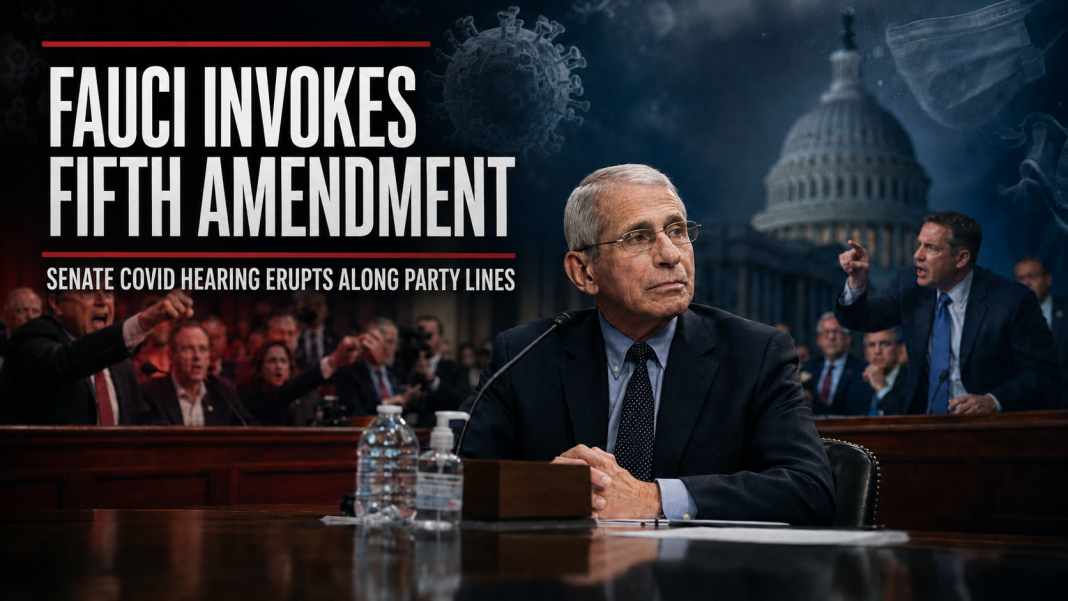
WASHINGTON — Dr. Anthony Fauci repeatedly invoked his Fifth Amendment right against self-incrimination Wednesday during a contentious Senate hearing examining federal research funding, the origins of COVID-19 and decisions made during the pandemic.
Fauci, the former director of the National Institute of Allergy and Infectious Diseases, appeared under subpoena before the Senate Homeland Security and Governmental Affairs Committee. He declined to provide substantive answers to questions from Chairman Rand Paul, R-Ky., and other Republican senators.
The hearing produced intense partisan exchanges but little new factual testimony. Republicans accused Fauci of withholding information and avoiding accountability, while Democrats described the proceeding as a politically motivated effort to validate conclusions the committee’s majority had already reached.
The committee has published the official hearing page and video.
Fauci explains decision to invoke Fifth Amendment
In his opening statement, Fauci said he was following the advice of his attorneys. He argued that Paul’s repeated calls for his prosecution created a risk that any new statement could be used to pursue a perjury or false-statements case against him.
Fauci accused Paul of conducting an “unhinged obsession” aimed at putting him “behind bars.” He then repeatedly responded to questions by stating that he respectfully declined to answer under the Fifth Amendment. CBS News
Invoking the Fifth Amendment is a constitutional protection against compelled self-incrimination. Its use does not, by itself, prove that a witness committed a crime.
Fauci has denied misleading Congress or concealing information about COVID-19’s origins. He has also maintained that the research at the center of his dispute with Paul did not meet the federal government’s operative definition of gain-of-function research.
Paul says Americans deserve answers
Paul opened the hearing by accusing Fauci of approving federal support for dangerous research in China and then resisting efforts to disclose the government’s role.
“The American people deserve answers.”
Paul said taxpayers deserved to know why the National Institutes of Health, through NIAID and grants involving EcoHealth Alliance, supported research connected to the Wuhan Institute of Virology. He contended that the risks of the research exceeded its potential benefits.
Paul also cited approximately 1,141 pages of Fauci’s pandemic-era diary. He argued that some private entries demonstrated uncertainty about COVID-19’s origin that was not adequately reflected in Fauci’s public statements.
Fauci’s representatives dispute that interpretation. They maintain that the diary is consistent with his public acknowledgment that scientists considered several possible origins during the pandemic’s early stages. Reuters
After Fauci refused to answer his questions, Paul warned that the committee would consider further action.
“There will be repercussions to your refusal to testify today.”
Paul subsequently announced that the committee had scheduled a vote on a resolution to hold Fauci in contempt of Congress. Such a resolution would represent another step in the process; it would not itself constitute a criminal conviction. CBS News
Republicans broaden criticism to pandemic policies
Other Republican senators questioned Fauci about school closures, masking recommendations, vaccine mandates, social-distancing guidance and the economic and educational consequences of pandemic restrictions.
Sen. Ron Johnson, R-Wis., said people harmed by pandemic policies continue to demand accountability. He sharply criticized federal health officials and questioned the safety and effectiveness of the government’s vaccination strategy.
Sen. Bernie Moreno, R-Ohio, concentrated on the effects of school closures, mandates and restrictions on families and small businesses. His remarks reflected the continuing anger among Americans who believe federal officials exercised too much authority while marginalizing people who questioned government policy.
Sen. James Lankford, R-Okla., raised concerns about declining childhood literacy and disruptions to routine vaccinations during the pandemic. He said the country still needs clarity concerning how critical decisions were made.
Because Fauci invoked the Fifth Amendment, the Republican senators’ accusations were not tested through substantive questioning and responses. Their comments should therefore be understood as lawmakers’ allegations and interpretations—not factual findings established by the hearing.
Peters calls investigation one-sided
Ranking Member Gary Peters, D-Mich., said the committee majority was using its investigative authority to legitimize conclusions reached years earlier.
“One-sided investigations designed to validate predetermined conclusions do not serve the American people.”
Peters said Congress should be examining current biological threats, reduced public-health capabilities and ways to prepare the country for another emergency. He characterized the hearing as an attempt to relitigate the past rather than strengthen national preparedness. Reuters
Peters also noted that Paul had previously called for Fauci to be fired, arrested and imprisoned. He argued that those statements raised questions about whether the investigation was designed to uncover facts or build a case against a predetermined target.
Democrats warned that making a single scientist the focus of the country’s unresolved pandemic disputes could undermine confidence in public institutions and discourage qualified experts from entering government service.
Republicans rejected the accusation that the investigation was one-sided. Paul called claims that Democrats had been denied access to committee records “categorically false” and said the majority had conducted a transparent inquiry.
Fauci attorney removed from hearing room
The hearing became especially heated when one of Fauci’s attorneys attempted to address the committee. Paul said the attorney had not been recognized and directed him to remain silent.
When the attorney continued trying to speak, Paul ordered security officers to remove him from the hearing room.
The attorney later told reporters that Fauci had a valid Fifth Amendment privilege and had the right to assert it. Peters said during the hearing that he wanted to hear the attorney’s legal explanation, but Paul declined to recognize him. CBS News
Does Biden’s pardon affect Fauci’s rights?
President Joe Biden issued Fauci a preemptive pardon on January 19, 2025. It covered potential federal offenses dating back to 2014 that were connected to Fauci’s government service or the federal response to COVID-19.
Paul argued that the pardon removed Fauci’s potential criminal exposure for past conduct and therefore weakened his basis for invoking the Fifth Amendment.
Fauci’s attorneys disagreed, contending that questioning could expose him to allegations involving conduct outside the pardon—including a new accusation that he made a false statement during the hearing. The pardon does not cover conduct occurring after it was issued. Reuters
The committee did not resolve that constitutional dispute during the hearing. Determining whether Fauci could be compelled to answer would require additional congressional proceedings and potentially judicial review.
COVID-19’s origin remains unresolved
The hearing revisited the long-running disagreement over whether COVID-19 emerged through natural animal-to-human transmission or resulted from a laboratory-related incident in Wuhan, China.
Different U.S. intelligence agencies have reached different assessments. The FBI and CIA have favored a laboratory-related origin, although the CIA expressed low confidence in its assessment. Other intelligence agencies and the National Intelligence Council have favored natural transmission.
The scientific and intelligence communities have not reached a definitive conclusion. China’s failure to provide complete access to early records, laboratory information and biological samples has made a final determination more difficult.
The hearing did not produce new evidence that conclusively established how the pandemic began.
What happens next?
Paul said the committee would consider a contempt resolution based on Fauci’s refusal to answer questions. Any effort to impose penalties would require additional procedural and legal steps.
A committee or Senate contempt action could lead to a referral, further negotiations over testimony or litigation concerning the scope of Fauci’s Fifth Amendment privilege. Whether the Justice Department would pursue any referral would be a separate decision.
The next phase will likely focus as much on constitutional procedure as on pandemic policy: whether Fauci’s pardon affects his right against self-incrimination, whether his opening statement changed that analysis and whether Congress can compel additional testimony.
The bottom line
The July 29 hearing demonstrated that Congress remains deeply divided over Fauci’s record and the federal government’s pandemic response.
Republicans presented the hearing as a long-delayed effort to secure accountability for research funding, disputed public statements and damaging pandemic restrictions. Democrats portrayed it as a partisan proceeding centered on punishing a political adversary rather than preparing the country for future threats.
Fauci’s decision to invoke the Fifth Amendment prevented either side from conducting a substantive examination of his decisions. As a result, the hearing generated significant political confrontation but established few new facts.