
Congress Faces a High-Stakes Fall: Government Funding, Defense, Agriculture and the Battle Over Federal Power
Lawmakers have reduced the immediate danger of an October shutdown, but disputes over federal grants, border enforcement, defense spending and the Farm Bill could produce another major confrontation in December.
By USCongress.us Staff
August 23, 2026
Congress will return to Washington this fall facing a crowded legislative calendar, a national election and another deadline for funding the federal government. Although both chambers have approved temporary funding measures, the House and Senate have not yet agreed on the same legislation. They also remain far from completing the 12 annual appropriations bills needed to establish federal spending for fiscal year 2027.
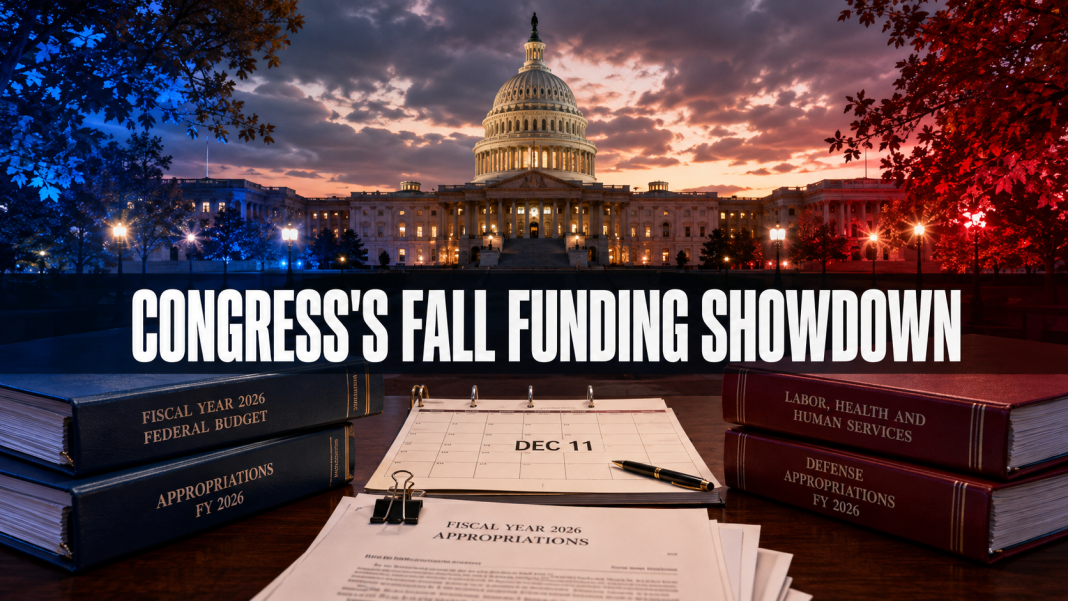
The central question is no longer simply whether Congress can prevent a shutdown on October 1. It is whether lawmakers can convert a short-term reprieve into a durable funding agreement before December—when appropriations, defense policy, agricultural programs and post-election political calculations could converge into one enormous legislative package.
The House passed a continuing resolution in July that would maintain most federal spending at current levels through December 4. The Senate subsequently amended the legislative vehicle, H.R. 6500, and approved a more expansive version funding the government through December 11. The Senate bill passed on August 8 by a decisive 90–6 vote, demonstrating unusually broad bipartisan support for avoiding an election-season shutdown. Official Senate roll-call vote
The remaining differences, however, are politically significant. Congress must settle them before current funding expires September 30.
Why Congress needs another continuing resolution
The federal fiscal year begins October 1. Under the regular appropriations process, the House and Senate are supposed to pass 12 separate spending bills covering defense, transportation, healthcare, education, justice, homeland security and other government operations.
That regular process is substantially behind schedule.
The House has passed only three of the fiscal year 2027 appropriations measures, while the Senate has not passed any of the 12 bills or reached a final agreement on overall discretionary spending levels. That makes completion of the full appropriations process before October 1 practically impossible. The Conference Board
A continuing resolution, commonly called a CR, temporarily maintains federal funding—usually at or near previously approved levels—while Congress continues negotiating. It prevents agencies from losing their legal authority to spend money, but it does not resolve the underlying disagreements.
Continuing resolutions can also create operational problems. Federal agencies may be prevented from starting new initiatives, revising contracts or shifting money to meet changing circumstances. The military often objects that temporary funding limits its ability to begin new weapons and construction programs. Domestic agencies similarly warn that operating under last year’s spending assumptions can disrupt grants, hiring and long-range planning.
The fall CR is therefore a bridge, not a final budget.
The House plan: A shorter and “cleaner” extension
House Republicans moved unusually early to pass their temporary funding bill. The House measure, approved 220–205, would extend funding through December 4. Six Democrats joined nearly every Republican in supporting it.
House Speaker Mike Johnson of Louisiana promoted the legislation as a clean continuation of existing funding without controversial policy provisions. House Appropriations Committee Chairman Tom Cole of Oklahoma also pushed for early passage, arguing that Congress should eliminate the danger of a shutdown during the closing weeks of the midterm campaigns.
“We want to take away the possibility of a shutdown between now and the election,” Cole said during consideration of the measure. Johnson similarly described the proposal as a straightforward extension with no legislative “poison pills.” CBS News
For Johnson, the legislation serves two political purposes. First, it demonstrates that the Republican-controlled House acted before the deadline. Second, it shifts pressure to the Senate and places Democrats in the position of either supporting temporary funding or explaining why they would risk a shutdown.
Most House Democrats opposed the original measure, however, arguing that Republican leaders developed it without sufficient bipartisan negotiations and omitted important protections concerning federal grants and immigration enforcement.
Representative Rosa DeLauro of Connecticut, the ranking Democrat on the House Appropriations Committee, emerged as one of its leading critics. DeLauro acknowledged that the House proposal did not contain a long list of partisan provisions, but she objected to its failure to prevent the administration from redirecting Customs and Border Protection funds toward Border Patrol operations. She also raised concerns about proposed changes to the federal grantmaking system.
After the Senate added those protections, DeLauro called the Senate bill “a clear improvement” over the House version. House Appropriations Committee Democrats
DeLauro’s changing position illustrates an important distinction: opposing one version of a continuing resolution does not necessarily mean supporting a shutdown. Legislators may vote against a funding bill because they prefer a different duration, spending level or policy limitation.
Collins and Murray construct a Senate compromise
The Senate measure is primarily the product of negotiations led by Appropriations Committee Chair Susan Collins, Republican of Maine, and Vice Chair Patty Murray, Democrat of Washington.
Collins promoted the compromise as a practical means of protecting federal workers, government services and communities that depend upon federal funding. Murray emphasized that the agreement would constrain executive actions that Democrats believe threaten Congress’s constitutional power over federal spending.
The Collins-Murray approach kept most programs operating at current levels through December 11, one week longer than the House proposal. It also incorporated specific funding adjustments—known as anomalies—for military healthcare, national security, disaster assistance and National Park Service operations.
One requested anomaly was not included: approximately $1 billion sought by the administration for preliminary work on a proposed class of battleships.
More importantly, the Senate bill would delay an Office of Management and Budget proposal giving the executive branch greater influence over federal grant awards. Critics of the proposed rule fear that an administration could approve, reject or cancel grants based on whether recipients align with White House policy priorities.
Collins expressed concern that the OMB proposal could politicize federal grants and harm rural communities, families and biomedical research. Her opposition gave the issue a bipartisan dimension rather than leaving it solely as a Democratic criticism of the Trump administration. Roll Call
The bill would postpone the OMB rule only for the duration of the continuing resolution. Consequently, the underlying struggle over presidential and congressional control of federal spending will return in December unless Congress adopts a permanent restriction.
The Senate measure also prevents additional fiscal year 2027 money from being redirected to Immigration and Customs Enforcement or Customs and Border Protection beyond substantial multiyear funding already approved for those agencies.
That provision helped attract Democratic support. It also creates one of the clearest points of disagreement with Republicans who want Congress to provide the administration with maximum flexibility to enforce immigration law.
The lawmakers promoting the Senate agreement
Several powerful congressional leaders are promoting the Senate version or the broader strategy of preventing an October shutdown:
- Senator Susan Collins, R-Maine: As Senate Appropriations Committee chair, Collins was the principal Republican architect of the bipartisan agreement. She has highlighted its temporary funding stability and its protection of federal grantmaking from political interference.
- Senator Patty Murray, D-Wash.: The committee’s leading Democrat helped negotiate the final package. Murray has promoted the legislation as a way to keep the government open while preserving Congress’s constitutional power of the purse.
- Senator John Thune, R-S.D.: The Senate majority leader scheduled and supported the legislation before the August recess. His floor-management role was essential because most major Senate legislation requires 60 votes to overcome procedural obstacles.
- Senator Chuck Schumer, D-N.Y.: The Senate Democratic leader supported the compromise and encouraged Democrats to provide the votes needed for passage.
- Representative Rosa DeLauro, D-Conn.: Although DeLauro opposed the House bill, she responded favorably to the Senate’s changes, particularly the restrictions involving Border Patrol funding and the OMB grant rule.
- Speaker Mike Johnson, R-La.: Johnson promoted the House version as an early, clean funding solution. Whether he will accept the Senate’s revisions is one of the most important unresolved questions.
- Representative Tom Cole, R-Okla.: The House Appropriations chairman advocated early action to prevent a third shutdown during the current Congress and remains central to any final House-Senate negotiation.
The 90 senators who ultimately supported H.R. 6500 included lawmakers across the ideological spectrum. Alabama Senators Katie Britt and Tommy Tuberville both voted for passage, as did Republican Senators Ted Cruz, Josh Hawley and Mike Lee and Democratic Senators Elizabeth Warren’s Massachusetts colleague—though Warren herself opposed it—along with moderates and progressives throughout the caucus.
The overwhelming vote does not mean that 90 senators endorse every section. It indicates that most concluded that maintaining government operations was more important than defeating the bill over individual objections.
Who is opposing or “demoting” the funding legislation?
Only six senators voted against final passage: Bill Cassidy of Louisiana, Tim Kaine of Virginia, Edward Markey of Massachusetts, Rand Paul of Kentucky, Bernie Sanders of Vermont and Elizabeth Warren of Massachusetts. Senator Lindsey Graham of South Carolina voted present, while James Lankford, Mitch McConnell and Thom Tillis did not vote. U.S. Senate Daily Press
That opposition crosses party and ideological boundaries.
Paul has long criticized federal spending, deficits and the repeated use of continuing resolutions rather than a disciplined appropriations process. Sanders and Warren generally approach funding disputes from the opposite direction, pressing for stronger domestic, healthcare and worker protections. Kaine and Markey have also emphasized congressional authority, national priorities and limitations on executive power in other fiscal and national-security debates.
The roll-call vote establishes that all six opposed the final bill. It does not, by itself, establish that they favored a shutdown. Without a bill-specific statement from each senator, it would be inaccurate to assign a single motivation to the six-member opposition bloc.
Opposition also exists outside the final “no” votes. Some conservative Republicans objected during negotiations that Collins and Murray had made unnecessary concessions to Democrats. Senator John Kennedy of Louisiana initially criticized the agreement and called for a cleaner CR, although he ultimately voted for final passage.
On the Democratic side, lawmakers who opposed the House measure could still support the Senate version. Their criticism was directed at what the House bill omitted—not necessarily at temporary funding itself.
The more consequential opposition may emerge in the House this fall. Johnson must decide whether to bring the Senate amendment to the floor unchanged, revise it or attempt to negotiate another compromise. If conservative Republicans reject the Senate additions and most Democrats continue opposing the original House bill, the speaker could face another narrow and unpredictable vote.
Defense funding and the Iran conflict
Government operations are only one part of Congress’s fall fiscal agenda. The administration has proposed approximately $1.5 trillion in total defense spending for fiscal year 2027: about $1.1 trillion in base funding and another $350 billion through reconciliation legislation. It has also sought more than $67 billion in supplemental funding related to operations against Iran and the replenishment of munitions. The Conference Board
Those requests will intensify disputes over the cost and authorization of military operations. Defense hawks will argue that the United States must replenish weapons, protect deployed personnel and maintain deterrence. Fiscal conservatives will question the overall cost, while war-powers advocates in both parties will demand clearer congressional authorization and reporting.
Congress must also complete the National Defense Authorization Act. The House passed its version 216–212, largely along party lines, but the Senate has not settled its overall funding level or major policy provisions.
The NDAA authorizes defense programs; appropriations legislation provides the money. Congress must therefore resolve both tracks. In December, defense authorization, Iran-related supplemental funding and annual appropriations could become interconnected.
That creates leverage for lawmakers who want higher defense spending, but it also creates risk. Adding election law, war funding or other controversial policies to a government funding agreement could destabilize the bipartisan coalition that supported the Senate CR.
The Farm Bill remains unfinished
Congress must also address the Farm Bill, which governs agricultural support, crop insurance, conservation, rural development and nutrition programs, including the Supplemental Nutrition Assistance Program.
The current Farm Bill was enacted in 2018 and has survived through temporary extensions. The House passed a new measure in April by a vote of 224–200, with 14 Democrats joining almost all Republicans. The Senate has not moved a bill out of committee.
The major disagreements involve SNAP eligibility and administration, error rates, state responsibility for program costs and the balance between nutrition spending and farm support.
Senate Agriculture Committee Chairman John Boozman of Arkansas is an important Republican promoter of moving a Farm Bill, while Democratic members are resisting reductions or administrative changes they believe could limit food assistance. House Agriculture Chairman Glenn “GT” Thompson of Pennsylvania has promoted the House package, but Senate inaction threatens to push the issue into the post-election session.
Agricultural legislation is not technically one of the 12 appropriations bills, but it shapes mandatory and discretionary spending across the Department of Agriculture. Failure to reach an agreement could result in another extension.
December may be more dangerous than October
The bipartisan Senate vote makes an October shutdown less likely, but Congress has not eliminated the danger. It has merely moved the most difficult decisions past the November election.
If the House accepts the Senate legislation and the president signs it, government funding will continue through December 11. Congress would then have only a short lame-duck session to choose among three options:
- Complete all 12 fiscal year 2027 appropriations bills.
- Combine several or all of them into a large omnibus or “minibus” package.
- Pass another continuing resolution extending funding into 2027.
The first option would restore regular budgeting but appears difficult given the current lack of progress. The second could attract enough bipartisan support but would generate complaints about a massive year-end bill negotiated by leadership. The third would avoid an immediate shutdown but transfer unfinished business to the next Congress.
The results of the midterm elections will influence every decision. A party expecting to gain power in January may prefer a short extension that preserves its ability to rewrite spending priorities. A party expecting to lose seats may push to lock in a longer agreement during the lame-duck session.
What Americans should watch this fall
The most important immediate action will occur when the House returns and decides how to handle the Senate amendment to H.R. 6500. Citizens should watch whether Johnson schedules a direct vote on the Senate bill and whether DeLauro and other Democrats recommend supporting it.
Other warning signs will include efforts to attach election-administration provisions, substantially higher defense funding or controversial immigration policies. Any of those additions could fracture the Senate’s 90-vote coalition.
Congress should also be judged on what happens after passage of the CR. Preventing a shutdown is important, but it is not equivalent to completing the budget. The deeper test is whether appropriators can negotiate full-year funding before December and provide agencies, service members, federal employees and grant recipients with predictable resources.
For now, the promoters of compromise—Collins, Murray, Thune, Schumer, Cole and potentially DeLauro—have the advantage. The 90–6 Senate vote gives the legislation strong political momentum.
Yet Speaker Johnson controls the House floor, President Trump retains veto power, and lawmakers remain divided over immigration, federal grants, defense spending and election policy. Those issues could transform an apparently routine funding extension into the defining congressional battle of fall 2026.
Congress may prevent an October shutdown. Whether it can prevent a December crisis is a much harder question.
References
- U.S. Senate. “Roll Call Vote 228: Passage of H.R. 6500, as Amended.” August 8, 2026. Records the Senate’s 90–6 vote and each senator’s position.
https://www.senate.gov/legislative/LIS/roll_call_votes/vote1192/vote_119_2_00228.htm - U.S. Senate Daily Press. “Friday, August 7, 2026.” Identifies the senators voting for and against the continuing resolution and related amendments.
https://www.dailypress.senate.gov/friday-august-7-2026/ - U.S. Senate Daily Press. “Senate Floor Schedule.” Provides the August recess and pro forma session schedule.
https://www.dailypress.senate.gov/ - House Committee on Appropriations. “Committee Takes Proactive Step to Prevent Partisan Shutdown, Protect Full-Year Appropriations Process.” July 17, 2026. Explains the House Republican continuing resolution and its December 4 expiration date.
https://appropriations.house.gov/news/press-releases/committee-takes-proactive-step-prevent-partisan-shutdown-protect-full-year - House Appropriations Committee Democrats. “DeLauro Statement on Continuing Resolution.” Discusses Representative Rosa DeLauro’s position on the Senate funding agreement, federal grants and border-enforcement funding.
https://democrats-appropriations.house.gov/news/press-releases/delauro-statement-continuing-resolution - Congressional Record. “Senate Proceedings on H.R. 6500.” August 7, 2026. Includes Senator Susan Collins’s floor remarks urging passage to prevent a government shutdown.
https://www.govinfo.gov/content/pkg/CREC-2026-08-07/html/CREC-2026-08-07-pt1-PgS4553-3.htm - CBS News. “House Passes Short-Term Bill to Punt Government Funding Fight Past Midterms.” July 2026. Covers the House’s 220–205 vote and statements from Speaker Mike Johnson, Chairman Tom Cole, Senator John Thune and Representative Rosa DeLauro.
https://www.cbsnews.com/news/house-government-funding-short-term-resolution-vote-december-4/ - CBS News. “Senate Pushes Ahead With Plan to Fund the Government Through Midterm Elections.” August 2026. Covers the Senate compromise and statements from Collins and DeLauro.
https://www.cbsnews.com/news/senate-government-funding-midterm-elections/ - PBS NewsHour. “House Passes Temporary Government Funding Bill Months Early.” July 2026. Provides independent reporting on the House bill and the political arguments surrounding it.
https://www.pbs.org/newshour/politics/house-passes-temporary-government-funding-bill-months-early - PBS NewsHour. “Senate Leaders Reach Funding Deal to Avoid Shutdown During Campaign Season.” August 2, 2026. Describes negotiations behind the Senate funding agreement.
https://www.pbs.org/newshour/politics/senate-leaders-reach-funding-deal-to-avoid-shutdown-during-campaign-season - Associated Press. “House Passes Temporary Government Funding Bill Months Early to Avoid Election-Season Shutdown.” July 2026. Reports the House vote and positions of Johnson, Cole and DeLauro.
https://apnews.com/article/a808a5428729a70cdc0250ab0a35611a - The Conference Board. “Congress Moves Closer to Avoiding Government Shutdown.” August 12, 2026. Analyzes the differences between the House and Senate resolutions, defense funding, the Farm Bill and the December deadline.
https://www.conference-board.org/research/policy-backgrounders/congress-moves-closer-to-avoiding-government-shutdown - Roll Call. “Senate’s Funding Patch Adds Trump Requests but Blocks Grant Rule.” August 2, 2026. Examines the OMB grantmaking rule and Senator Susan Collins’s objections.
https://rollcall.com/2026/08/02/senates-funding-patch-adds-trump-requests-but-blocks-grant-rule/ - FASEB. “Senate’s Continuing Resolution Blocks OMB’s Proposed Rule.” August 12, 2026. Summarizes H.R. 6500’s grantmaking provisions and the need for additional House action.
https://www.faseb.org/journals-and-news/washington-update/inside-the-beltway-scoop-852531c3b5217b02d9850446ee821fa5 - National Association of Counties. “Senate Passes Bill to Fund the Government Through December 11 and Delay OMB Rule.” August 10, 2026. Explains the resolution’s effect on federal grants and local governments.
https://www.naco.org/news/us-congress-passes-continuing-resolution-fund-government-through-midterm-elections
Sources accessed August 23, 2026. Legislative provisions, schedules and lawmakers’ positions may change as Congress resumes regular business.