
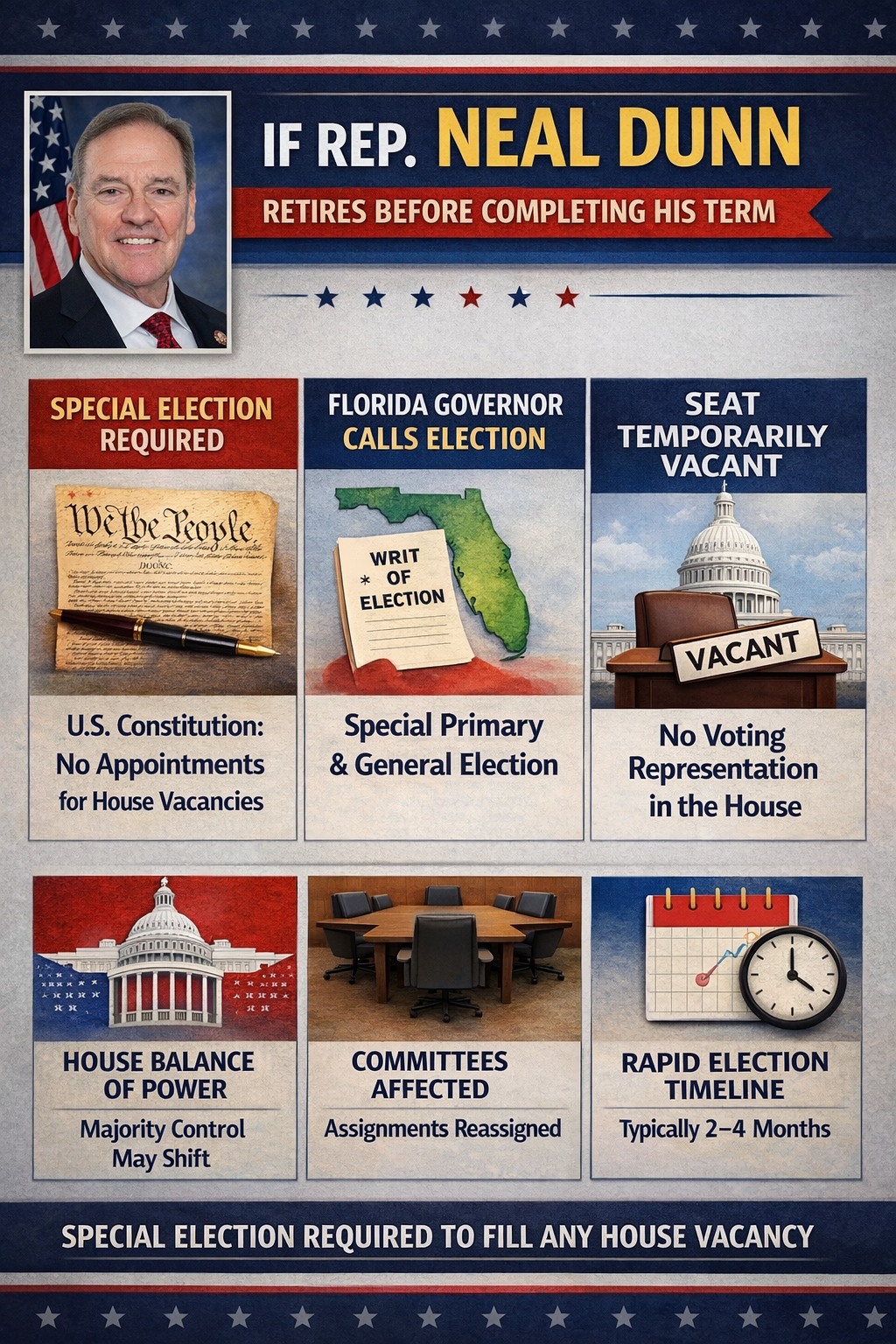

If Neal Dunn, a Republican representing Florida in the U.S. House of Representatives, were to retire or resign before completing his term, the outcome would be governed by the U.S. Constitution and Florida election law. Unlike U.S. Senators, House members cannot be replaced by appointment — every vacancy must be filled through a special election.
Here’s what would happen and how it could impact Congress.
Constitutional Requirement: Special Elections Only
Article I, Section 2, Clause 4 of the U.S. Constitution requires that:
“When vacancies happen in the Representation from any State, the Executive Authority thereof shall issue Writs of Election to fill such Vacancies.”
This means:
- There are no temporary appointments for U.S. House seats.
- Florida’s Governor must call a special election.
- The seat remains vacant until voters choose a replacement.
Florida’s Special Election Process
If Rep. Dunn resigned mid-term:
- Governor Issues Writ of Election
The Governor of Florida would formally declare the vacancy and schedule a special election. - Special Primary (If Needed)
If multiple candidates from a party qualify, a special primary election would be held. - Special General Election
Voters in Florida’s congressional district would elect a new representative.
Typical Timeline
Special elections in Florida typically take 2 to 4 months from vacancy to final vote, depending on statutory timelines and ballot preparation requirements.
During that time:
- The district would have no voting representation in the U.S. House.
- Constituent services may continue through remaining staff, but legislative votes cannot be cast.
Impact on the U.S. House Balance of Power
The political impact depends heavily on the margin in the House at the time of the vacancy.
If the majority party holds only a narrow advantage:
- Losing even one vote temporarily could affect passage of major legislation.
- Committee ratios could shift.
- Party leadership may prioritize a rapid special election.
If the House margin is wider, the immediate legislative impact may be minimal — though still politically significant.
What If He Announces Retirement but Finishes His Term?
If Rep. Dunn simply announces he will not seek reelection:
- He continues serving until the end of his term.
- The seat is contested in the next regularly scheduled federal election (November of even-numbered years).
- There is no special election in this scenario.
This is the most common form of congressional retirement.
What If He Resigns After Winning Reelection?
If a member wins reelection but resigns before being sworn in for the next Congress:
- The seat is considered vacant at the start of the new term.
- Florida must still conduct a special election.
Why House Vacancies Differ From Senate Vacancies
Many states allow governors to temporarily appoint U.S. Senators when vacancies occur. However:
- The U.S. Constitution does not allow appointments for the House.
- Every vacancy must be filled by voters through an election.
This ensures direct representation but can leave districts temporarily unrepresented.
Summary: Key Takeaways
If Rep. Neal Dunn were to leave office before completing his term:
- A special election is mandatory
- Florida’s Governor must set the election schedule
- The district would temporarily lack voting representation
- The House balance of power could be affected, depending on margins
For voters and political observers, the timing of any resignation — and the broader congressional landscape — would determine the full impact.
Sources
- U.S. Constitution, Article I, Section 2, Clause 4 – Vacancies in the House of Representatives
- Florida Statutes § 100.111 – Special Elections
- U.S. House of Representatives, Office of the Clerk – “Vacancies in the House”
- Congressional Research Service (CRS), House Vacancies and Special Elections: Frequently Asked Questions