
Medicare — the federal health insurance program primarily for people age 65 and older and for some people with disabilities — is one of the most consequential social programs in the United States. With more than 67 million Americans enrolled, it plays a central role in U.S. health care, representing a significant share of federal spending and a lifeline for older adults and people with long-term health needs.
In 2026, Congress is actively considering a suite of legislative actions, funding decisions, and policy reforms that will shape Medicare’s future — from how doctors are paid to what services are covered and how high prescription drug costs are addressed. The challenge for lawmakers is balancing the program’s financial sustainability with beneficiaries’ needs for access, affordability, and quality care.
Below is a detailed look at the major areas where Congress is focused on Medicare.
1. Extending and Reforming Medicare Telehealth Coverage
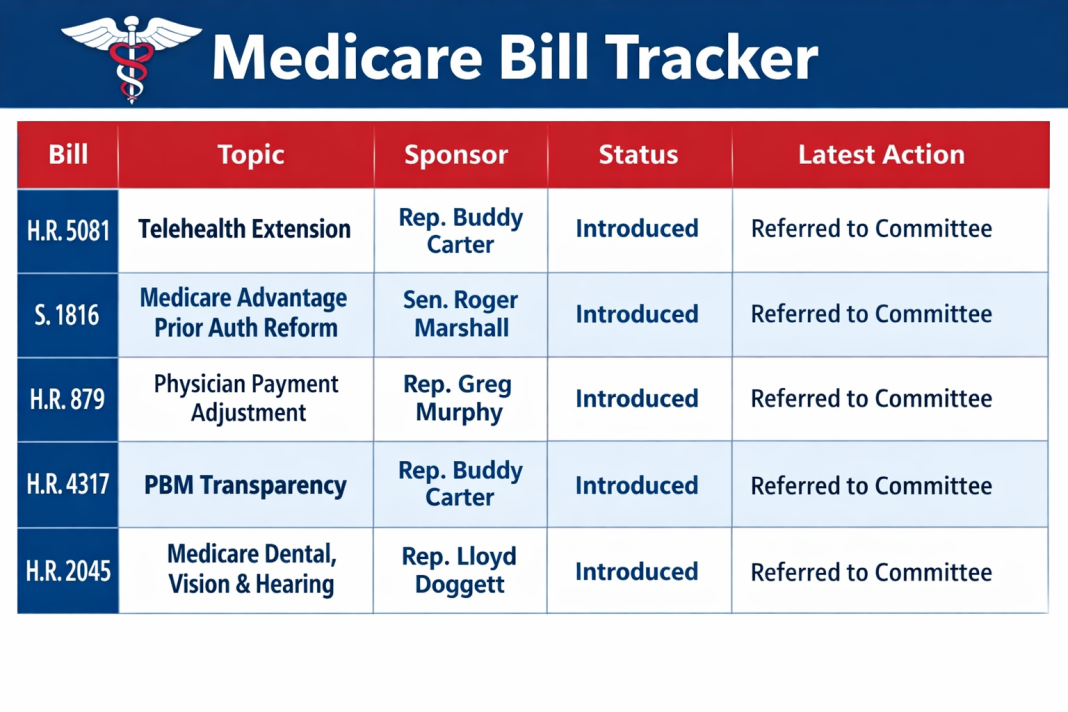
One of the most urgent issues legislated this year has been the continuation of Medicare telehealth flexibilities — a series of provisions that allow Medicare to cover virtual health visits almost as broadly as in-person care.
During the COVID-19 pandemic, Congress temporarily expanded telehealth access to allow beneficiaries to receive services remotely. Those temporary telehealth waivers were set to expire, creating uncertainty for providers and patients alike.
In response, Congress included telehealth extensions in recent federal funding legislation. The House passed a funding package that would extend telehealth flexibilities through Dec. 31, 2027, along with provision for the hospital-at-home waiver through 2030, meaning beneficiaries could continue receiving certain acute services at home when clinically appropriate.
Extending telehealth in Medicare is significant because remote services have helped older adults access primary care and specialty services without travel barriers. But these provisions must be periodically renewed, so lawmakers continue to debate whether Medicare should make these telehealth flexibilities permanent.
2. Medicare Drug Price Negotiations and Cost Control
Another major focus for Congress — building on policy enacted in the Inflation Reduction Act of 2022 — is Medicare’s authority to negotiate prescription drug prices.
In recent weeks, the Biden administration, with broad regulatory authority shaped by congressional statute, announced the addition of 15 new high-cost medications to Medicare’s drug price negotiation program, covering drugs used for conditions such as type 2 diabetes, HIV, arthritis, and depression.
This negotiation program represents one of Congress’s most significant reforms to address rising Medicare prescription drug spending. By negotiating prices for drugs that account for substantial Medicare expenditures, lawmakers hope to lower costs for beneficiaries and taxpayers.
This negotiation power was created by Congress and is partly implemented through administrative rule-making by the Centers for Medicare & Medicaid Services (CMS). Although not a direct vote by Congress every year, these negotiations are rooted in federal law and reflect congressional intent to curb drug costs.
However, drug pricing reform remains a topic of political debate and litigation, with some industry groups challenging the process. Congress continues to oversee and support this negotiation effort, even as it evaluates additional reforms, such as limits on out-of-pocket costs or broader authority over Part B drugs (which are often infused or injected in clinical settings).
3. Bipartisan Health Appropriations with Targeted Medicare Provisions
For 2026, Congress’s appropriations process — the annual law that funds federal departments and programs — has become a vehicle for targeted Medicare reforms.
Both the House and Senate appropriations committees have developed a bipartisan health care funding package that pairs discretionary funding for the Department of Health and Human Services with specific Medicare policy changes.
Key elements include:
- Extension of telehealth and hospital-at-home authorities, avoiding disruptions when pandemic waivers expire.
- Initial steps toward site-neutral payment reform, which aims to reduce Medicare’s higher payments for services delivered in hospital outpatient departments versus physician offices.
- Enhanced incentives for physician participation in alternative payment models that reward value rather than volume of care.
- New transparency measures for pharmacy benefit managers (PBMs), intermediaries that play a major role in drug pricing and beneficiary costs.
These targeted reforms illustrate a growing bipartisan concern in Congress about payment equity, cost containment, and access while avoiding more controversial blanket changes.
4. Medicare Advantage Payment Reform
Medicare Advantage, the private-plan option that covers more than half of all Medicare beneficiaries, is also a major congressional focus.
Lawmakers and federal regulators are closely watching how payments to Medicare Advantage insurers evolve. Recently, a proposed 0.09% increase in Medicare Advantage payments for 2027 — far smaller than previous years’ increases — caused stock declines for major health insurers and sparked debate about whether flat payment growth could reduce benefits or increase costs to beneficiaries.
Congress has oversight authority here, including annual hearings where CMS officials testify and justify rate proposals. The House and Senate both have members urging robust oversight so that Medicare Advantage plans remain sustainable without compromising beneficiary access to services.
In parallel, lawmakers have proposed prior authorization reform to reduce unnecessary delays in care within Medicare Advantage. Bipartisan, bicameral legislation — the Improving Seniors’ Timely Access to Care Act of 2025 — has strong co-sponsor support, with more than 248 House members and 64 senators backing reforms to streamline prior authorization practices for seniors.
5. Fundamental Medicare Expansion Proposals
While much of Congress’s activity focuses on targeted reforms, some lawmakers are pushing transformational proposals that would fundamentally reshape Medicare.
Among the most ambitious is the Medicare for All Act (introduced in both chambers as S.1506 in the Senate and H.R.3069 in the House), which envisions establishing a universal, federal health insurance system administered by the Department of Health and Human Services that would automatically enroll all U.S. residents and cover a broad range of services.
Although Medicare for All has garnered significant co-sponsorship and public debate, it remains far from majority support in either chamber and faces steep political hurdles. Republicans generally oppose such a single-payer model, while moderate Democrats have expressed concerns about cost, transition logistics, and impacts on private coverage.
Nonetheless, the presence of this bill underscores the ongoing ideological debate within Congress about the scope of federal health care — from incremental reforms within Medicare to sweeping universal coverage.
6. Medicare Physician Payment and Sustainability Debates
Medicare’s payment system for physicians and other providers is another subject of congressional concern.
Physician payment rates — particularly how Medicare updates the physician fee schedule — have become contentious. The current system has been criticized as financially unsustainable for many practices due to statutory payment cuts, lack of inflation-based updates, administrative burdens, and other challenges. Health organizations like the American Medical Association (AMA) are lobbying Congress to enact legislation that would stabilize payment rates and move toward value-based care models.
Although Congress has not enacted sweeping physician payment reform, lawmakers regularly consider proposals to adjust payment formulas and expand alternative payment models. The bipartisan appropriations package noted above includes incentives for physician participation in these models, reflecting congressional interest in payment reform even if comprehensive legislation remains elusive.
7. Oversight and Advisory Roles: MedPAC and Aging Committee
Beyond direct legislation, Congress works through advisory bodies and oversight committees that influence Medicare’s evolution.
One key entity is the Medicare Payment Advisory Commission (MedPAC), an independent legislative branch agency that regularly reports to Congress on Medicare payments, beneficiary access and quality, and other program issues. MedPAC’s analyses and recommendations often shape legislative debates and appropriations decisions.
Another important body is the U.S. Senate Special Committee on Aging, which conducts oversight hearings and studies issues affecting older Americans, including Medicare. While it lacks direct legislative jurisdiction, its investigations and reports often spur policy discussions and influence committee action.
8. Fiscal Context and Long-Term Solvency Concerns
A core long-term challenge for Congress is Medicare’s financial sustainability. The program’s trust fund faces projected financing pressures as the population ages and health care costs rise.
Congressional budget analysts have noted that without significant changes, Medicare spending will place increasing strain on federal deficits and long-term fiscal balances. Reconciliation laws like the 2025 budget act included provisions that could trigger automatic spending reductions (sequestration) if deficits rise — potentially reducing Medicare funding by hundreds of billions over the next decade.
These fiscal pressures create a backdrop for nearly every Medicare policy debate, whether it’s drug pricing, payment reforms, or benefit changes. Lawmakers from both parties acknowledge the need to control costs — but differ sharply on the preferred methods.
9. Broader Health Policy Impacts and Intersections
Medicare policy does not exist in isolation. Congressional actions on other health programs — such as Medicaid, the Affordable Care Act (ACA), and health insurance marketplaces — indirectly affect Medicare beneficiaries.
For example, failure to extend enhanced ACA premium tax credits created coverage affordability challenges for many Americans, pushing additional pressure onto hospital systems and Medicare spending.
Congress also continues to oversee broader changes to federal health policy, such as site-neutral payment initiatives, PBM reforms, and alternative payment models, all of which can reduce program costs and improve care coordination for Medicare beneficiaries.
Conclusion
In 2026, the U.S. Congress is deeply engaged in shaping the future of Medicare through a range of legislative actions, appropriations decisions, and oversight hearings. Lawmakers are attempting to strike a balance between expanding access — such as through telehealth — and controlling costs, whether through drug price negotiation, physician payment reform, or Medicare Advantage oversight.
Medicare remains a central part of the nation’s social safety net and a major piece of federal fiscal policy. The decisions Congress makes now — from telehealth extensions to long-term financing strategies — will have profound implications for millions of Americans who depend on Medicare for health care security.
Throughout these debates, one theme is clear: Congress recognizes that Medicare must evolve to remain both financially sustainable and responsive to beneficiaries’ needs — but there remains deep political disagreement on how best to achieve that goal.