
The Core Divide (Big Picture)
- Republicans prioritize border control, enforcement, and rule of law
- Democrats prioritize humanitarian protections, legal pathways, and integration
Both sides say they want a functional immigration system—but disagree on what “functional” means and what comes first.
🔴 Republican Concerns (Primary Issues)
1. Border Security
- Argue the border is effectively uncontrolled
- Support physical barriers, increased Border Patrol staffing, and surveillance
- View illegal entry as a national security and public safety risk
2. Enforcement of Existing Laws
- Believe laws already on the books aren’t being enforced
- Oppose policies that limit deportations or allow catch-and-release
- Strongly oppose “sanctuary” jurisdictions
3. Asylum System Abuse
- Say asylum is being used as a loophole for economic migration
- Want higher standards and faster removals for denied claims
4. Impact on Workers & Public Services
- Concerned about wage suppression for low-income Americans
- Argue migrants strain schools, hospitals, and local budgets
Bottom line:
Republicans tend to say: “Fix the border first—then talk about everything else.”
🔵 Democratic Concerns (Primary Issues)
1. Humanitarian Protections
- Emphasize the right to seek asylum under U.S. and international law
- Oppose policies seen as separating families or endangering migrants
2. Pathway to Legal Status
- Support legalization or citizenship for undocumented immigrants already in the U.S. (especially Dreamers)
- Argue mass deportations are unrealistic and harmful
3. Economic Contributions
- View immigration as essential to labor shortages (healthcare, agriculture, construction)
- Highlight long-term economic growth and tax contributions
4. Opposition to Criminalization
- Resist framing immigration primarily as a crime issue
- Prefer civil enforcement and community-based solutions
Bottom line:
Democrats tend to say: “Protect people first—reform the system while doing so.”
Where the Two Parties Collide Most
| Issue | Republicans | Democrats |
|---|---|---|
| Border wall | Support | Oppose |
| Asylum limits | Tighten | Preserve |
| Deportations | Expand | Limit |
| Sanctuary policies | Oppose | Support |
| Legalization | Rarely | Strongly |
| Enforcement funding | High priority | Conditional |
Why Congress Stays Stuck
- Sequencing fight
- GOP: Enforcement → Reform
- Dems: Reform → Enforcement
- Political incentives
- Immigration energizes base voters on both sides
- Compromise can trigger primary challenges
- Trust gap
- Republicans don’t trust Democrats to enforce laws after reform
- Democrats don’t trust Republicans to legalize anyone after enforcement
Republicans see immigration as a border enforcement failure; Democrats see it as a humanitarian and legal system failure—and until they agree on the problem, they won’t agree on the fix.
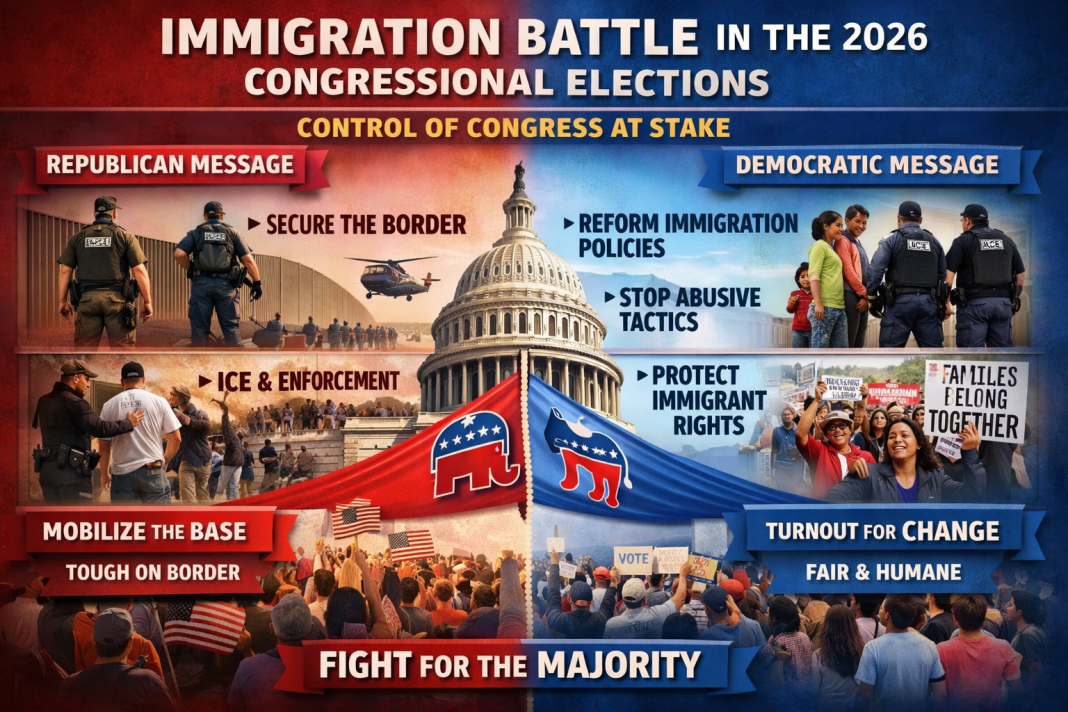
Here’s how the immigration dispute between Republicans and Democrats is directly shaping the 2026 U.S. congressional elections — including how it is influencing campaigns, voter messaging, and control of Congress:
🗳️ 1. Immigration Has Become a Central Campaign Issue
Republicans
- The GOP is tied closely to strict immigration enforcement, influenced by actions from President Trump’s administration. This includes high-profile Immigration and Customs Enforcement (ICE) operations that are controversial in some communities.
- Some Republican lawmakers worry that these enforcement actions — especially fatal shootings by federal agents — are hurting the party’s political standing on immigration, an issue that was once a clear strength.
- GOP candidates in competitive districts and Senate races must balance satisfying the base’s demand for enforcement with not alienating moderate or independent voters concerned about civil liberties and due process.
Democrats
- Democrats are using criticism of immigration enforcement practices as a campaign tool. They are tying GOP candidates to controversial actions by ICE and DHS to motivate turnout — especially among Hispanic and younger voters.
- Democrats are rhetoric around “reimagining” immigration enforcement (rather than extremism like “abolish ICE”) to appeal to broad audiences while pushing for accountability reforms.
- In some races, Democratic groups are running ads specifically attacking GOP support for ICE funding and tying that to public safety concerns.
🔥 2. Government Funding Fights Have Become Election Messaging
- The issue of funding Homeland Security and immigration enforcement has even triggered a partial government shutdown in early 2026, over disputes about immigration policy and enforcement reforms.
- Democrats blocked GOP-backed spending without changes to enforcement practices.
- Republicans insist on strict enforcement without concessions.
- These standoffs give both parties talking points for campaign ads — Republicans emphasize law and order, Democrats emphasize accountability and fairness.
🎯 3. Electoral Impacts in Key Races
U.S. Senate
- Several Senate seats in swing states — e.g., Maine — are being contested where immigration enforcement policies are a focal point of Democratic attack ads.
- Democrats target GOP incumbents for supporting controversial enforcement tactics or large ICE budgets.
- GOP incumbents defend their stance as necessary for border security and law enforcement.
U.S. House
- Immigration policy is a key wedge issue in competitive House districts.
- Democrats see immigration as a way to energize their voters and appeal to suburban and independent voters frustrated with enforcement excesses.
- Republicans see the issue as consolidating their base but risk losing votes among moderates if immigration enforcement is portrayed negatively.
📊 4. National Polling Shows Mixed Effects
- On the 2026 generic congressional ballot, Democrats have been polling ahead on many issues overall — yet Republicans still hold an advantage on immigration as a top issue.
- This dynamic means immigration isn’t a guaranteed win for either party — how it plays out depends on:
- Local context (e.g., border states vs. inland districts)
- Candidate messaging (moderate vs. hard-line positions)
- Current events (e.g., enforcement actions that make news during the campaign)
📌 Summary: Why This Matters for 2026
- Election messaging: Immigration is being used by Democrats to spotlight GOP enforcement actions as extreme or harmful — forcing Republicans to defend policies that could be unpopular in swing areas.
- Policy leverage: Democrats are tying immigration enforcement to major votes (like funding bills and government shutdowns), which become campaign fodder.
- Voter mobilization: Both parties believe immigration is a motivator among key voter blocs — Republicans for base turnout, Democrats to attract independents, minorities, and younger voters.
- House and Senate control: With narrow margins in both chambers, even a handful of competitive districts or Senate seats could hinge on how immigration is perceived locally.
In essence: immigration in 2026 is not just a policy dispute — it’s an election strategy battleground that can influence who controls the House and Senate and how future laws are shaped. If you want, I can break down specific competitive races where immigration is especially driving the narrative and vote.
Sources: Congress.gov, official agency releases (DHS/CBP/USCIS/DOJ), and reputable news reporting. Last updated: February 02, 2026. Corrections: Contact USCongress.us.