
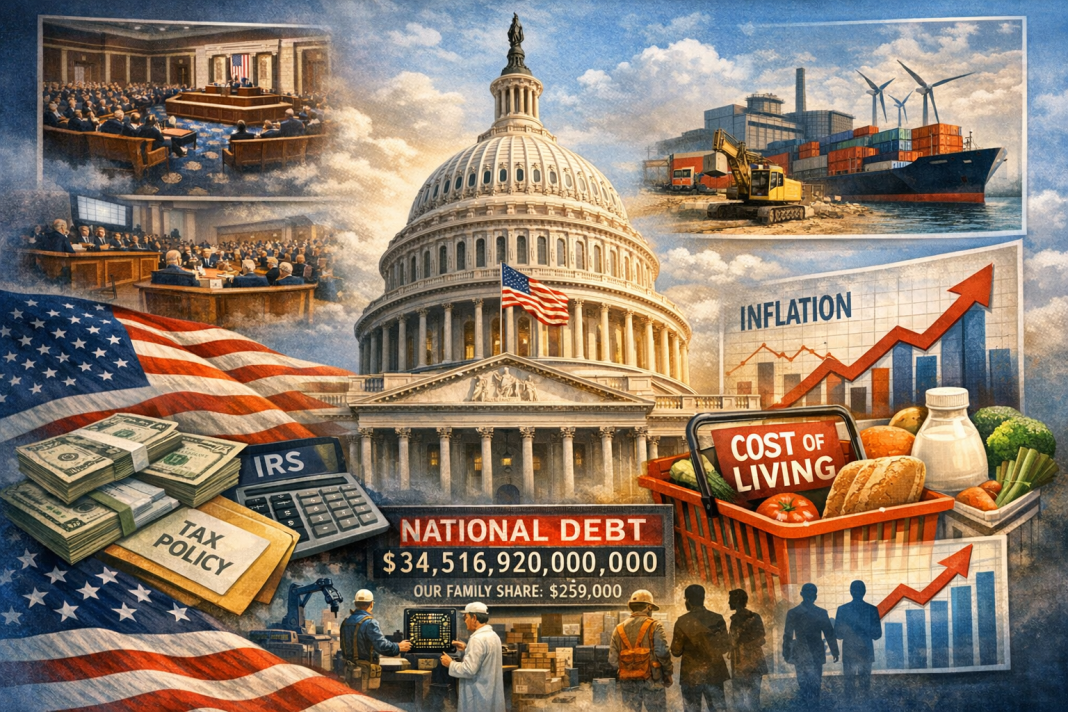

In 2026, the U.S. economy sits at the intersection of recovery, correction, and reinvention. Inflation has moderated from historic highs earlier in the decade, but costs of living remain elevated. Interest rates, though stabilizing, continue to influence housing, consumer credit, and federal borrowing costs. Global instability, supply-chain realignments, and rapid technological change all add pressure to domestic economic policy.
At the center of these forces is United States Congress, which holds constitutional authority over taxation, federal spending, borrowing, and economic regulation. Unlike the executive branch or the Federal Reserve, Congress directly writes the laws that shape fiscal policy and indirectly influences nearly every sector of the economy.
In 2026, congressional action on the economy can be grouped into six major areas:
- Fiscal policy and federal spending
- Inflation and cost-of-living relief
- Tax policy and revenue debates
- Debt, deficits, and long-term fiscal sustainability
- Jobs, wages, and workforce development
- Industrial policy, trade, and competitiveness
Together, these efforts define how lawmakers are attempting to guide economic stability while navigating a polarized political environment and a highly engaged electorate.
Fiscal Policy: Spending, Budget Battles, and Economic Direction
One of Congress’s most direct economic tools is federal spending. Each year, lawmakers must pass appropriations bills to fund government operations. In 2026, this process continues to be contentious, reflecting broader disagreements over the size and role of government in the economy.
Discretionary Spending
Congress divides federal spending into discretionary and mandatory categories. Discretionary spending—covering defense, education, infrastructure, and research—requires annual approval. Economic debates in 2026 center on:
- Defense spending amid global security concerns
- Infrastructure investment to support long-term growth
- Funding for scientific research and innovation
- Education and workforce training programs
Supporters argue that targeted spending stimulates growth, boosts productivity, and strengthens U.S. competitiveness. Critics warn that excessive spending fuels deficits and increases inflationary pressure.
Mandatory Spending and Economic Impact
Mandatory programs like Social Security and Medicare automatically grow unless Congress changes the law. While these programs are often discussed in terms of social policy, they have enormous macroeconomic implications:
- They influence consumer spending patterns
- They affect federal borrowing needs
- They shape long-term fiscal sustainability
In 2026, Congress continues to debate whether and how to reform these programs without reducing benefits for current retirees.
Inflation and Cost-of-Living Relief
Although inflation has cooled from earlier peaks, many Americans still feel economic strain. Congress has responded with a mix of oversight, targeted legislation, and political pressure on regulators.
Oversight of Monetary Policy
While Congress does not set interest rates, it oversees Federal Reserve through hearings and legislation. Lawmakers in 2026 continue to:
- Question Fed officials about rate policy
- Examine the impact of tightening on housing and small businesses
- Debate proposals to adjust the Fed’s mandate
These hearings are not merely symbolic; they influence market expectations and public confidence.
Housing and Rent Pressures
Housing costs remain one of the largest drivers of household inflation. Congressional proposals in 2026 include:
- Incentives for housing construction
- Zoning and permitting reform discussions
- Expansion of affordable housing tax credits
While housing policy often involves state and local governments, Congress’s role in financing and regulation has significant economic ripple effects.
Tax Policy: Growth, Fairness, and Political Divides
Tax policy remains one of the most politically charged economic issues before Congress. In 2026, debates focus on whether the existing tax structure promotes growth while maintaining fairness.
Individual Taxes
Lawmakers continue to discuss:
- Middle-class tax relief
- Adjustments to child and family tax credits
- Inflation indexing for tax brackets and deductions
Supporters argue that targeted tax cuts increase disposable income and stimulate consumer spending. Critics counter that such cuts worsen deficits without guaranteeing long-term growth.
Corporate and Business Taxes
Congress also examines corporate tax policy in light of global competition:
- Maintaining competitiveness with other advanced economies
- Preventing profit-shifting and offshore tax avoidance
- Encouraging domestic investment and job creation
These debates often involve balancing economic efficiency with revenue needs.
Debt, Deficits, and Long-Term Fiscal Sustainability
Federal debt remains one of the most persistent economic challenges facing Congress. In 2026, lawmakers continue to confront the tension between short-term economic support and long-term fiscal responsibility.
Debt Ceiling Politics
Periodic debt ceiling debates have become a recurring source of market uncertainty. Congress uses these moments to:
- Extract policy concessions
- Signal fiscal priorities
- Debate the role of borrowing in economic management
Even the threat of default can affect interest rates, stock markets, and global confidence in U.S. financial leadership.
Interest Costs and Crowding Out
As debt grows, so do interest payments. In 2026, interest on the national debt represents one of the fastest-growing federal expenditures. Economists warn that rising interest costs may:
- Crowd out productive investment
- Limit future policy flexibility
- Increase pressure for tax hikes or spending cuts
Congressional committees increasingly treat debt service as a core economic issue rather than a technical accounting matter.
Jobs, Wages, and Workforce Development
Employment remains a central measure of economic health, and Congress continues to shape labor market outcomes through legislation and oversight.
Workforce Training and Reskilling
As automation and artificial intelligence reshape industries, Congress has focused on:
- Expanding vocational and technical education
- Funding reskilling programs for displaced workers
- Strengthening apprenticeships and employer partnerships
These initiatives aim to reduce structural unemployment and ensure that economic growth translates into broad-based opportunity.
Wage Policy and Labor Standards
Debates over minimum wage levels, overtime rules, and worker classification persist in 2026. Supporters argue higher wages boost consumer demand and reduce inequality. Opponents warn of increased costs for small businesses and potential job losses.
Industrial Policy, Trade, and Global Competitiveness
Congress has increasingly embraced a more active role in shaping the structure of the U.S. economy.
Domestic Manufacturing and Supply Chains
Recent legislation emphasizes:
- Semiconductor and advanced manufacturing
- Domestic sourcing of critical materials
- Reducing reliance on geopolitically sensitive suppliers
These policies reflect lessons learned from pandemic-era disruptions and geopolitical tensions.
Trade Policy and Tariffs
Congressional oversight of trade policy remains intense. In 2026, lawmakers debate:
- Tariff impacts on consumers and producers
- Enforcement of trade agreements
- Balancing national security with free-market principles
Trade decisions affect inflation, employment, and long-term growth prospects.
Political Dynamics and the 2026 Economic Outlook
Economic policy in Congress does not exist in a vacuum. Election cycles, party control, and public opinion shape legislative outcomes. In 2026:
- Divided government increases reliance on incremental policy changes
- Oversight hearings become tools for economic messaging
- Budget negotiations reflect broader ideological divides
Despite these challenges, Congress continues to play a decisive role in guiding economic conditions.
Conclusion: Congress’s Economic Legacy in Motion
The U.S. economy in 2026 reflects both the strengths and tensions of a complex legislative system. Through spending decisions, tax policy, oversight of monetary authorities, and long-term fiscal debates, Congress remains a central architect of economic outcomes.
While no single bill or hearing can determine prosperity, the cumulative impact of congressional action shapes growth, stability, and opportunity for millions of Americans. As lawmakers navigate inflation concerns, debt pressures, workforce transitions, and global competition, their decisions will define not only the economic present—but the economic legacy of this decade.
Sources & References
- United States Congress – Legislative text, committee hearings, budget resolutions, and economic policy debates
https://www.congress.gov - Congressional Budget Office – Federal budget outlooks, deficit projections, and economic analyses
https://www.cbo.gov - Federal Reserve – Monetary policy reports, inflation data, and testimony before Congress
https://www.federalreserve.gov - U.S. Department of the Treasury – National debt data, interest cost reports, and fiscal policy materials
https://home.treasury.gov - Bureau of Economic Analysis – GDP growth, national income, and economic trend data
https://www.bea.gov - Bureau of Labor Statistics – Employment, wage growth, inflation, and productivity statistics
https://www.bls.gov - Government Accountability Office – Oversight reports on federal spending efficiency and economic programs
https://www.gao.gov - Joint Committee on Taxation – Tax policy estimates and revenue impact analyses
https://www.jct.gov
Editorial Note
This article synthesizes publicly available legislative actions, hearings, budget documents, and economic data current through 2026. Interpretations are intended for informational purposes and do not represent endorsements of any political party or policy position.