

Introduction
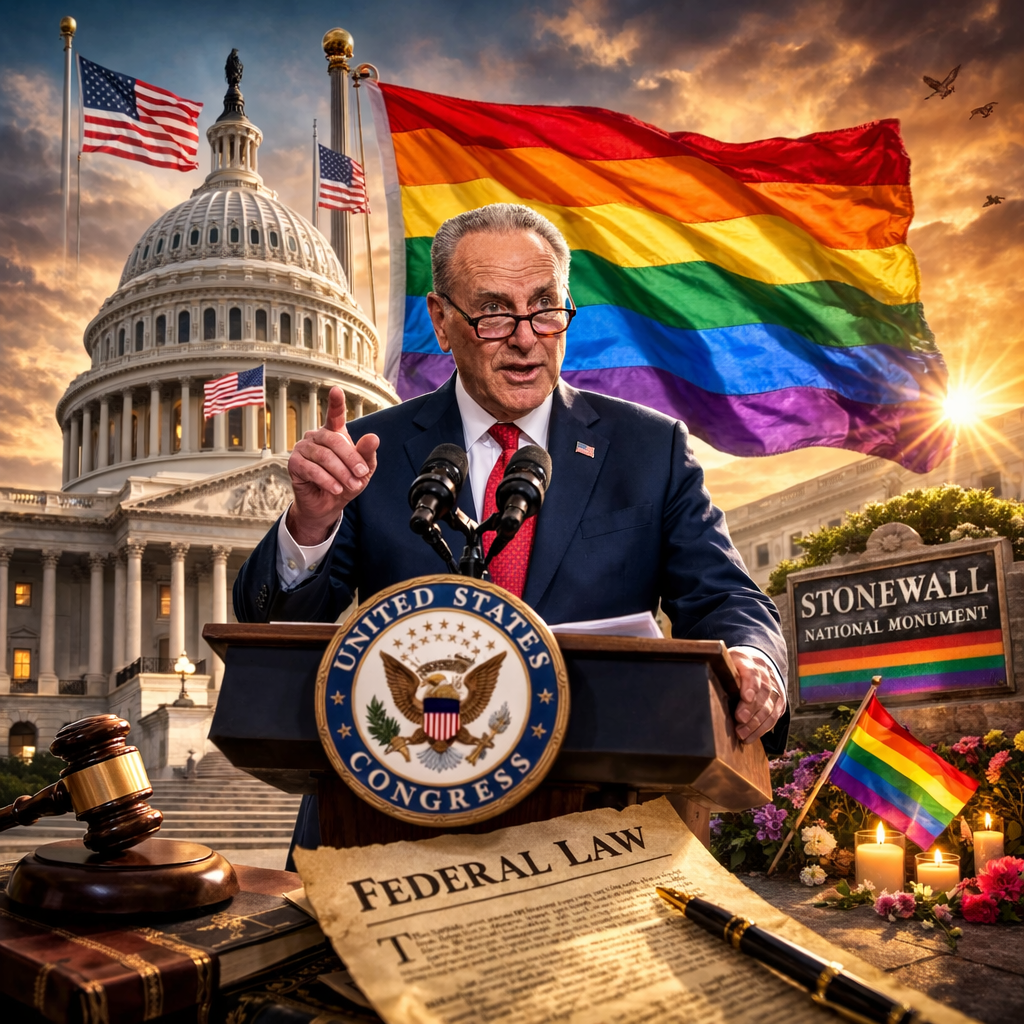
In early 2026, a cultural and political controversy erupted that quickly moved from a historic New York City park into the center of national politics. At the heart of the dispute is Senate Democratic Leader Chuck Schumer of New York and his effort to introduce federal legislation authorizing the LGBTQ+ Pride flag at the Stonewall National Monument and potentially other historically relevant federal sites.
Supporters describe the proposal as a civil-rights protection measure designed to preserve LGBTQ+ history. Critics argue it politicizes federal spaces and blurs long-standing rules governing which flags may fly on government property. While the financial cost is minimal, the symbolic stakes are significant — touching on federal authority, cultural recognition, and the role of government in representing social movements.
This article explains the origins of the dispute, what Schumer’s legislation would do, the arguments on both sides, and why the issue resonates nationally.
The Incident That Sparked the Debate
The controversy began when the National Park Service removed a rainbow Pride flag from the Stonewall National Monument in February 2026. The federal government cited policy restricting flag displays on federal property to official government flags.
Stonewall is not just another park. It commemorates the 1969 Stonewall uprising — widely considered the birth of the modern LGBTQ+ rights movement.
The Pride flag had flown at the monument in recent years but was not congressionally authorized.
The removal triggered swift backlash from New York officials, activists, and national lawmakers, who argued the action erased LGBTQ+ history and visibility.
Local leaders and activists quickly re-raised the flag alongside the American flag in defiance of federal action.
Federal Flag Rules: Why the Flag Was Removed
Federal flagpoles are governed by longstanding policies that generally limit displays to:
- The U.S. flag
- Official agency flags
- POW/MIA flag
- Other congressionally authorized flags
The National Park Service said removal was necessary to comply with federal guidelines restricting non-official displays.
This policy framework is central to the dispute: the Pride flag had symbolic significance but lacked formal congressional authorization.
Schumer’s Legislative Response
Following the removal, Schumer announced he would introduce legislation to formally authorize the Pride flag.
His proposal would:
1. Designate the Pride Flag as a Congressionally Authorized Flag
Schumer said Congress must act to “permanently protect the Pride flag and what it stands for.”
Authorization would allow the flag to be displayed at certain federal sites without violating flag protocols.
2. Protect the Flag at Stonewall
The proposal aims to ensure the Pride flag cannot be removed again from the Stonewall monument.
3. Establish Recognition of LGBTQ+ Civil Rights History
Supporters say the measure recognizes Stonewall as a civil-rights landmark and protects its symbolic representation.
What “Congressional Authorization” Means
Some headlines suggested the bill would give the Pride flag the “same legal protection as the U.S. flag.” In practice, congressional authorization would not elevate it above the American flag.
Instead, authorization:
- Allows display on federal property
- Places it alongside other authorized flags
- Protects it from administrative removal
- Clarifies compliance with federal flag rules
Examples of congressionally authorized flags include the POW/MIA flag and certain military service flags.
Political Support and Opposition
Supporters in Congress
Several lawmakers have supported Schumer’s effort, including:
- Kirsten Gillibrand (D-NY)
- Dan Goldman (D-NY)
- Jerry Nadler (D-NY)
These lawmakers condemned the flag’s removal and pushed for its restoration.
Administration Position
Federal officials cited long-standing flag policies and neutrality rules governing public property.
Republican and Conservative Criticism
Critics argue:
- Federal property should display only official government symbols.
- Creating exceptions politicizes national sites.
- Symbolic disputes distract from policy priorities.
Some critics frame the proposal as government endorsement of political symbolism rather than preservation of history.
Why Stonewall Matters Symbolically
Stonewall holds unique cultural importance. It was designated a national monument in 2016 to recognize its role in LGBTQ+ civil rights history.
Supporters argue removing the Pride flag diminishes the historical context of the site.
Critics counter that the monument itself already commemorates the history, and the display of modern symbols is not necessary for preservation.
Broader National Context
The Stonewall dispute is part of a larger national debate about flags and public symbolism.
Across the United States, controversies have emerged over:
- Pride flags at schools and city buildings
- Black Lives Matter flags on public property
- Confederate symbols and monuments
- Religious displays in public spaces
At issue is whether government spaces should remain strictly neutral or reflect evolving social recognition.
Arguments Supporting Authorization
1. Civil Rights Recognition
Advocates say the Pride flag symbolizes equality and recognition of LGBTQ+ Americans.
2. Historical Context
Stonewall is the birthplace of the modern LGBTQ+ rights movement, making the flag historically appropriate.
3. Preventing Political Erasure
Supporters argue that without legal protection, future administrations could remove symbols tied to civil-rights history.
Arguments Opposing Authorization
1. Government Neutrality
Opponents believe federal spaces should display only official national symbols.
2. Slippery Slope Concerns
Critics warn that authorizing one symbolic flag could lead to demands for others.
3. Political Polarization
Some argue the move deepens cultural divisions and politicizes historic sites.
Cost to Taxpayers
The financial impact of the legislation is minimal.
Direct costs
- Flag procurement and maintenance
- Routine staff labor
- Administrative updates
These costs typically amount to hundreds or thousands of dollars — standard operational expenses.
Potential indirect costs
- Legal challenges if policies are contested
- Security costs during demonstrations
- Congressional administrative time
There is no evidence of major federal spending tied directly to Pride flag authorization.
Public Opinion and Generational Trends
Public attitudes toward LGBTQ+ recognition have shifted significantly. Surveys show about 7–8% of U.S. adults identify as LGBTQ+, with much higher identification among younger Americans.
Younger generations tend to support public recognition measures at higher rates, while older demographics often prioritize institutional neutrality.
This generational divide shapes how symbolic issues like flag displays are perceived nationwide.
Likelihood of Passage
The legislation faces uncertain prospects.
Factors affecting passage include:
- A divided or opposition-controlled Congress
- Competing legislative priorities
- Broader political polarization
Even if the bill does not pass, the debate has already elevated the issue nationally.
Why This Debate Matters
The Pride flag controversy is about more than a piece of fabric on a flagpole.
It raises broader questions:
- How should the federal government represent civil-rights history?
- Should public spaces remain symbolically neutral?
- Who decides what symbols represent American values?
- How do political shifts affect historical recognition?
These questions extend far beyond Stonewall.
Conclusion
Chuck Schumer’s proposal to authorize the Pride flag at the Stonewall National Monument represents a flashpoint in America’s ongoing debate over history, symbolism, and public space.
Supporters see the effort as protecting civil-rights heritage and preventing political erasure. Opponents warn it risks politicizing federal property and eroding neutrality standards.
The financial cost is negligible, but the cultural implications are profound.
As Congress considers the proposal, the dispute highlights a central tension in modern America: how to balance tradition and neutrality with recognition of evolving civil-rights history.
Whatever the legislative outcome, the debate ensures that Stonewall — and the broader struggle for equality it represents — remains firmly in the national conversation.
Sources
Reuters. Trump administration removes rainbow Pride flag from New York’s Stonewall monument. February 10, 2026.
https://www.reuters.com/world/us/trump-administration-removes-rainbow-pride-flag-new-yorks-stonewall-monument-2026-02-10/
TIME. New York leaders vow to fight removal of Pride flag at Stonewall National Monument. 2026.
https://time.com/7377621/stonewall-national-monument-new-york-officials-pride-flag-removed-trump-administration/
Associated Press. NY officials raise rainbow flag at Stonewall in rebuke of federal removal. 2026.
https://apnews.com/article/f6a4a93ff1cf12f7462e7fa23b4cb14e
The Washington Post. Pride flag flies again at Stonewall Inn amid dispute. February 2026.
https://www.washingtonpost.com/nation/2026/02/12/pride-flag-stonewall-inn-trump/
The Guardian. Pride flag reinstated at Stonewall after removal controversy. February 2026.
https://www.theguardian.com/us-news/2026/feb/12/pride-flag-reinstated-stonewall
U.S. Department of the Interior / National Park Service. Policies governing flag displays on federal property.
https://www.doi.gov/
https://www.nps.gov/
U.S. Congress. Statements and legislative actions regarding authorization of Pride flag display at Stonewall National Monument (2026).