
1. Congress Is Bicameral: Two Chambers Vote Separately
The U.S. Congress consists of:
- The House of Representatives (435 voting members)
- The Senate (100 Senators)
Before any measure becomes law, both chambers must vote to approve it in the same form. Once both chambers agree, the bill is sent to the President for signature or veto.
2. What Members Vote On
Members of both chambers vote on:
- Bills and joint resolutions (which can become law)
- Amendments to bills
- Procedural motions
- Nominations (Senate)
- Treaties (Senate)
Each chamber has specific areas of authority—for example, the Senate confirms presidential appointments and ratifies treaties, while the House initiates tax and revenue bills.
3. Types of Voting in the House of Representatives
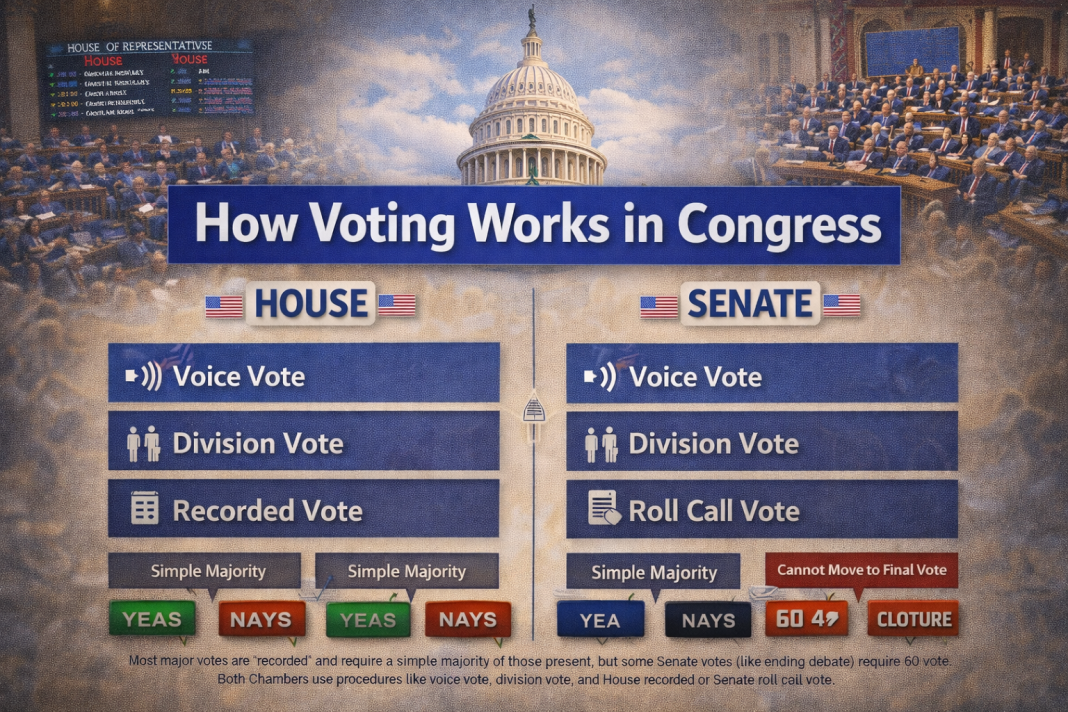
In the House, votes can occur in several ways, depending on how the outcome is determined and whether individual positions are recorded.
• Voice Vote
Members respond aloud to a question by saying “aye” or “no.” The presiding officer then announces which side has prevailed. There is no individual record of who voted which way.
• Division (Standing) Vote
Members stand to be counted. This gives a more accurate sense of the tally than a voice vote, but does not record individual names.
• Yea and Nay Vote / Roll Call
This is a recorded vote—members’ individual votes are captured, typically through the House’s electronic voting system. Most major legislative decisions use this method.
• Recorded Vote
By rule, if one-fifth of a quorum (usually at least 44 House members) request it after a voice vote, a recorded vote by name must be held.
The House usually votes electronically (buttons at a console), except in rare cases of system failure or special situations.
4. Types of Voting in the Senate
The Senate uses similar but slightly different practices:
• Voice Vote
As in the House, Senators say “aye” or “no” together, and the presiding officer announces the result. This is common for uncontroversial matters.
• Division Vote
Senators stand to be counted if a voice vote’s result is unclear. It is less commonly used.
• Roll Call Vote
The Senate clerk calls each Senator’s name, and each answers “yea,” “nay,” or “present.” This yields a record of how every Senator voted and is typically used for major legislation or when requested by a Senator.
5. Special Voting Rules in the Senate
Unlike the House, the Senate’s procedural rules give the minority party tools to influence when votes occur:
• Filibuster and Cloture
To end extended debate (a filibuster) and proceed to a final vote on most legislation, the Senate usually must invoke cloture, which requires the support of at least three-fifths of the Senate—typically 60 votes.
This means that even before a roll call vote on a bill, Senators often engage in procedural votes to limit debate.
• Vote-a-Rama
During budget and reconciliation sessions, the Senate may conduct a “vote-a-rama,” a rapid series of votes on numerous amendments in quick succession. This is an established Senate practice to exhaust the amendment process.
6. What Majority Is Needed
House of Representatives
- Simple majority (218 of 435) is usually required to pass legislation.
Senate
- For most legislation, a simple majority (51 of 100) is needed to pass once debate is closed, but as noted, 60 votes are typically required to invoke cloture and advance the bill to final passage.
Higher thresholds apply for specific actions:
- Two-thirds vote to override a presidential veto or convict an impeached official
- Two-thirds vote to ratify treaties
- Expelling a Senator also generally requires a two-thirds vote.
7. Recording and Transparency
Members’ votes on most major issues are published and become part of the public record, often referred to as roll call votes. These records are widely available through sources such as the Congressional Record and official House and Senate vote archives.
The use of recorded votes allows constituents, researchers, and journalists to analyze how each legislator voted on specific issues.
8. What Happens After Votes
Once both chambers pass the same bill:
- The measure moves to the President for signature or veto.
- If vetoed, Congress may attempt to override the veto with a two-thirds majority in both chambers.
9. Other Voting Contexts
Congress also votes in special contexts, such as in joint sessions—for example, to count Electoral College votes after presidential elections—which have their own procedural rules.
Summary: How Voting Works in Congress
| Chamber | Methods of Vote | Recorded? | Typical Threshold |
|---|---|---|---|
| House | Voice vote, Division, Recorded/Roll Call | Yes (for roll call/recorded) | Simple majority |
| Senate | Voice vote, Division, Roll Call | Yes (for roll call) | Simple majority for passage; 60 to end debate / invoke cloture |
Both chambers use a mix of informal and formal voting procedures, from quick voice votes to detailed roll call votes that record each member’s position. These mechanisms reflect not just the rules of procedure, but also strategic choices by leadership and individual members about how and when to push for public accountability on key issues.
Source:
The information in this article is based on official congressional rules, government publications, and nonpartisan civic education resources, including:
- U.S. House of Representatives – The Legislative Process
https://www.house.gov/the-house-explained/the-legislative-process - U.S. Senate – Voting and Procedures
https://www.senate.gov/about/powers-procedures/voting.htm - USA.gov – How Laws Are Made
https://www.usa.gov/how-laws-are-made - Congressional Research Service (CRS) – Voting in the House and Senate
CRS Report 98-228 (House Voting Procedures)
CRS Report 96-452 (Senate Voting Procedures)
https://www.congress.gov/crs-products - Congress.gov – Legislation, Roll Call Votes, and Congressional Record
https://www.congress.gov - Office of the Clerk, U.S. House of Representatives – Electronic Voting in the House
https://history.house.gov/Institution/Electronic-Voting/Electronic-Voting/ - Government Publishing Office (GPO) – House Practice: A Guide to the Rules, Precedents and Procedures of the House
https://www.govinfo.gov - The White House – Legislative Branch Overview
https://www.whitehouse.gov/government/legislative-branch/