
Overview
Concerns about voter fraud have played a prominent role in U.S. political discourse, particularly since the expansion of mail-in voting during the COVID-19 pandemic. While allegations of widespread fraud are common, verified cases of voter fraud remain rare and typically involve isolated individuals rather than coordinated schemes. Federal courts, state audits, and law enforcement investigations have consistently found no evidence of fraud on a scale capable of altering national election outcomes.
That said, every state experiences occasional violations of election law, and states have taken varying steps to improve election security, transparency, and public confidence.
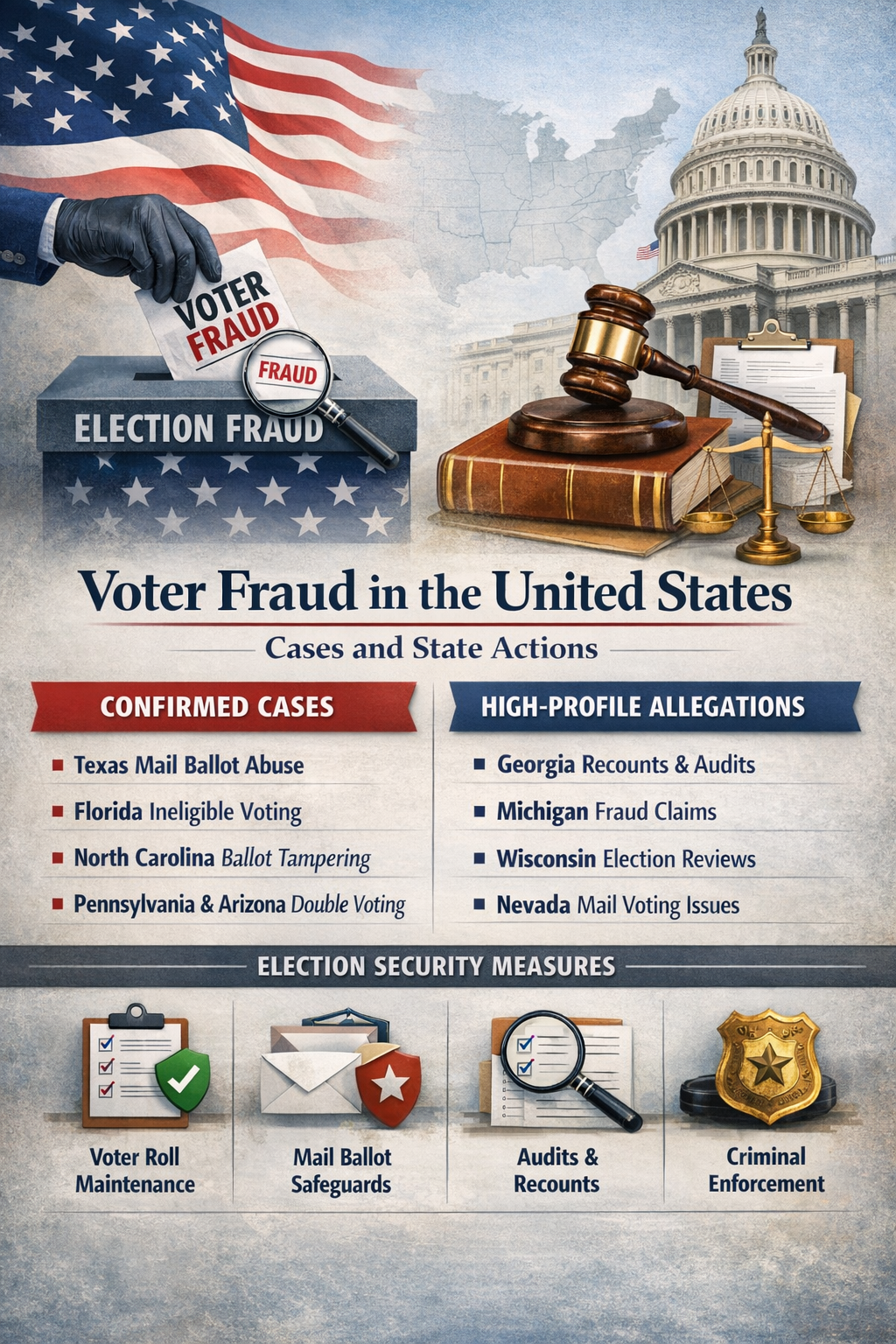
States With Confirmed Voter Fraud Cases
Confirmed cases generally involve double voting, voting while ineligible, ballot tampering, or false registration. These cases are usually detected through audits, voter roll maintenance, or criminal investigations.
Texas
Texas has prosecuted cases involving mail ballot misuse, ineligible voting, and falsified registration information.
Actions taken include enhanced signature verification, tighter eligibility rules for absentee voting, and the expansion of state-level election integrity investigations.
Florida
Florida has documented cases of individuals voting while ineligible, often involving confusion over felony voting rights restoration.
Actions taken include the creation of an Office of Election Crimes and Security, increased coordination between election officials and courts, and voter eligibility audits.
North Carolina
North Carolina uncovered absentee ballot misconduct during the 2018 congressional election cycle, involving ballot collection and tampering.
Actions taken include stricter absentee ballot witness requirements, enhanced chain-of-custody rules, and broader investigative authority for election officials.
Pennsylvania
Pennsylvania has identified small numbers of double voting and outdated voter registration records, often through routine checks.
Actions taken include improved voter roll maintenance, death record matching, and participation in interstate voter data sharing programs.
Arizona
Arizona has confirmed isolated cases involving residency violations and attempted double voting.
Actions taken include post-election audits, ballot tracking systems, and expanded documentation of ballot chain-of-custody.
States With High-Profile Allegations but No Proven Widespread Fraud
Several states have been the focus of repeated allegations, audits, recounts, and lawsuits. In these cases, investigations confirmed election results while identifying administrative or procedural weaknesses rather than criminal fraud.
Georgia
Multiple recounts and audits upheld certified results.
Actions taken include voter ID requirements for absentee ballots, regulations on ballot drop boxes, and expanded state oversight of local election offices.
Michigan
Court challenges and investigations found no evidence of outcome-changing fraud.
Actions taken include risk-limiting audits, updated tabulator testing, and voter roll updates.
Wisconsin
Legislative reviews identified procedural inconsistencies but not systemic fraud.
Actions taken include clarifying absentee ballot guidance and expanding post-election audits.
Nevada
Claims centered on expanded mail voting.
Actions taken include ballot signature curing processes, ballot tracking, and mandatory post-election audits.
Common Election Security Measures Adopted by States
Across the country, states have implemented reforms aimed at strengthening election integrity and public confidence:
- Voter Roll Maintenance
- Removal of deceased voters
- Address updates
- Interstate data sharing
- Mail-Ballot Safeguards
- Signature verification
- Ballot tracking
- Witness or ID requirements
- Drop box security standards
- Audits and Recounts
- Risk-limiting audits
- Hand recounts in close races
- Logic and accuracy testing of voting machines
- Criminal Enforcement
- Election-specific law enforcement units
- Public reporting of prosecutions and convictions
- Transparency Measures
- Public audit reports
- Poll watcher access
- Documented chain-of-custody procedures
Conclusion
While voter fraud does occur in the United States, it is rare, isolated, and routinely detected through existing safeguards. Extensive investigations by courts, state officials, and federal agencies have found no evidence of widespread fraud capable of altering the outcome of recent federal elections.
State governments continue to refine election laws, strengthen enforcement, and expand auditing practices in response to both verified violations and public concerns. The ongoing challenge for policymakers is balancing access to voting, election security, and public trust in the democratic process.
Sources:
- U.S. Department of Justice, Election Crimes Manual
- National Conference of State Legislatures (NCSL), Voter Fraud and Election Integrity
- Brennan Center for Justice, Election Security and Voter Fraud Analysis
- Heritage Foundation, Election Fraud Database
- State election offices and attorneys general public reports
- Federal and state court rulings on election challenges (2016–2024)