
📌 Midterm Elections
The 2026 U.S. federal elections take place on Tuesday, November 3, 2026. These are called midterm elections because they occur midway through a president’s term (in this case during President Donald Trump’s second term).
In these elections:
- All 435 seats in the U.S. House of Representatives are up for election.
- 33 of the 100 seats in the U.S. Senate are up for regular election (Class 2), plus a couple of special elections for seats vacated earlier in the term.
There will also be elections for thousands of state legislative seats and some governors, but the most significant national impact comes from the House and Senate races.
🏛️ Why These Elections Matter
🔹 U.S. House of Representatives
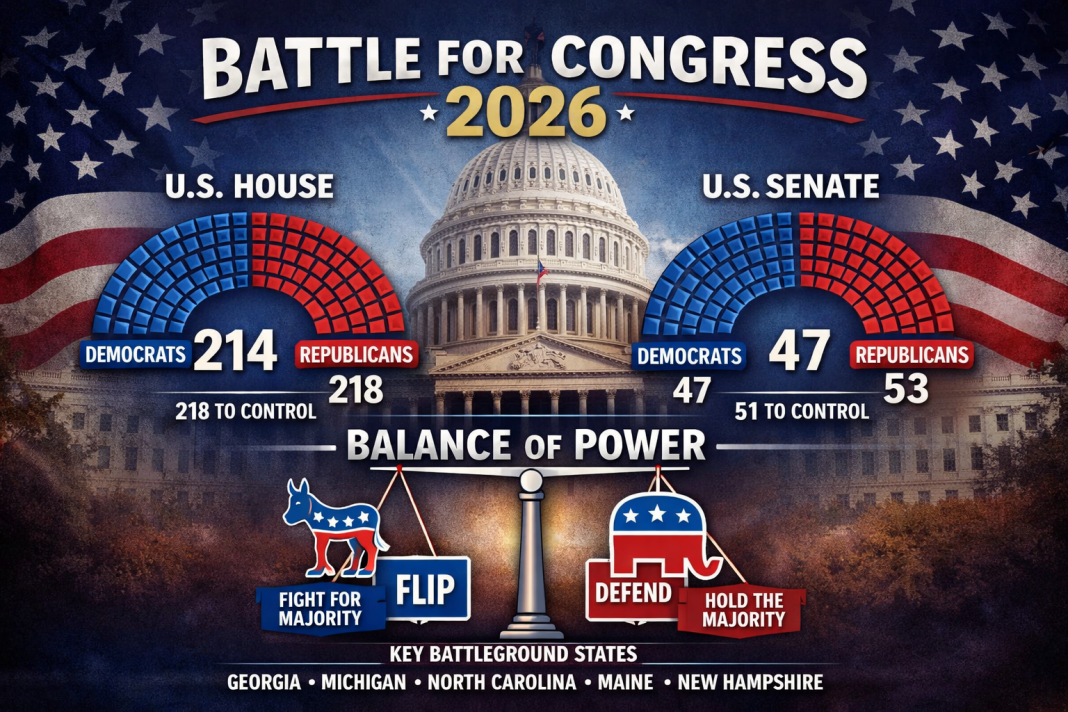
- Republicans currently hold a narrow majority in the House — roughly 218 seats to Democrats’ 214 (with a few vacancies).
- Because every House seat is contested every two years, the House is very sensitive to shifts in voter sentiment nationwide.
- Historically, the party in the White House tends to lose seats in midterm elections, especially in the House — going back decades, the incumbent party has lost House seats in almost every midterm since 1946.
👉 That means Democrats have a strong statistical chance of winning back the House majority in 2026 if they gain a net of at least 3 seats.
🔹 U.S. Senate
- Republicans currently hold a majority in the Senate (about 53 seats), while Democrats (plus two independents who caucus with them) hold around 47.
- Of the seats up in 2026:
- Democrats are defending 13 seats
- Republicans are defending 20 seats.
- To flip the Senate, Democrats would need a net gain of at least 4 seats.
Senate races tend to be more expensive and less predictable than House races because they are statewide. That makes control of the chamber harder to change, but still possible, especially in tight battleground states.
📊 Current Predictions & Factors (Not Guaranteed)
These are predictions and trends reported by political analysts — not certainties:
- Analysts suggest Democrats may have a good chance to win the House due to the typical midterm pattern and current political climate.
- Some forecasts see scenarios where Democrats win the House but Republicans keep the Senate, resulting in divided control.
- Fundraising, voter mobilization efforts, and redistricting maps (like recent changes in California and other states) could play big roles in close races.
🧠 What This Means for Policy
The outcome of these elections will influence what Congress can do for the next two years (2027–2028), including:
- Federal spending priorities
- Health care policy
- Medicare/Medicaid reforms
- National budget and debt decisions
- Oversight of the executive branch
- Judicial appointments and confirmations
If one party controls the House, Senate, and White House, they can more easily pass their agenda. If control is split between chambers, legislation often becomes harder and requires compromise.
🗳️ Summary
| Body | Seats Up | Current Control | What’s Needed to Flip |
|---|---|---|---|
| House | All 435 | Republican majority | Democrats need ~3+ net seats |
| Senate | ~33 + specials | Republican majority | Democrats need ~4+ net seats |
elow is a state-by-state breakdown of the 2026 fights that matter most for control of the Senate and House, using the most-cited public rating/forecast frameworks:
- Cook Political Report (CPR) ratings (updated Jan 12, 2026)
- Inside Elections ratings (updated Jan 12, 2026)
- For “model-style” forecasts, I also include generic ballot + simulation options and prediction markets you can track daily.
Senate 2026: state-by-state (what flips control)
Starting point: Republicans hold 53 seats, Democrats (including allied independents) 47; Democrats need +4 net seats for a majority.
The “control” states (Toss-up / near Toss-up)
These are the states most likely to decide the Senate:
| State | Seat status | Cook | Inside Elections |
|---|---|---|---|
| GA | D Ossoff | Toss Up | Toss-up |
| MI | D Open (Peters) | Toss Up | Toss-up |
| NC | R Open (Tillis) | Toss Up | Toss-up |
| ME | R Collins | Toss Up | Tilt R |
| NH | D Open (Shaheen) | Lean D | Tilt D |
Next tier (competitive but with clearer lean)
| State | Seat status | Cook | Inside Elections |
|---|---|---|---|
| AK | R Sullivan | Lean R | Lean R |
| OH | R Husted (special) | Lean R | Lean R |
| IA | R Open (Ernst) | Likely R | Likely R |
| TX | R Cornyn | Likely R | Likely R |
| MN | D Open (Smith) | Likely D | Likely D |
The rest of the map (safe/solid by ratings)
Solid D states: CO, DE, IL (open), MA, NJ, NM, OR, RI, VA
Solid R states: AL (open), AR, FL (special), ID, KS, KY (open), LA, MS, MT, NE, OK, SC, SD, TN, WV, WY (open)
What this implies for Senate control:
With only ~5 true battlegrounds (GA/MI/NC/ME/NH), the likeliest “paths” are:
- GOP holds Senate if they split these roughly 3–2 (especially if they keep NC and ME).
- Democrats need a near-sweep: hold GA + win MI + win NH + flip NC and/or ME, and then also overcome the GOP lean in AK/OH to reach +4.
Track as a “model” (probabilities):
- Kalshi Senate control market (probability-style)
House 2026: by state (where the seat swing is likely to come from)
All 435 House seats are up, and control usually comes down to a relatively small number of competitive districts.
Cook’s competitive House seats — where they cluster (by state)
Cook’s published list of competitive races (Likely/Lean/Toss-up categories) shows the biggest clusters here: CA (5), MI (4), NY (4), TX (4), PA (4), then AZ/CO/FL/IA/NV/OH/VA (3 each).
Here are the competitive districts by state from Cook’s list:
- California (5): CA-13, CA-21, CA-22, CA-45, CA-48
- Michigan (4): MI-07, MI-08, MI-10, MI-04
- New York (4): NY-03, NY-04, NY-17, NY-19
- Texas (4): TX-15, TX-28, TX-34, TX-35
- Pennsylvania (4): PA-01, PA-07, PA-08, PA-10
- Arizona (3): AZ-01, AZ-02, AZ-06
- Colorado (3): CO-03, CO-05, CO-08
- Florida (3): FL-07, FL-13, FL-23
- Iowa (3): IA-01, IA-02, IA-03
- Nevada (3): NV-01, NV-03, NV-04
- Ohio (3): OH-01, OH-09, OH-13
- Virginia (3): VA-01, VA-02, VA-07
- New Hampshire (2): NH-01, NH-02
- New Jersey (2): NJ-07, NJ-09
- Wisconsin (2): WI-01, WI-03
- Single-district states: AK-AL; ME-02; MN-02; MT-01; NC-01; NC-11; NE-02; NM-02; OR-05; TN-05; WA-03
Ballotpedia battleground cross-check: Ballotpedia identifies 42 House battleground races and explicitly uses Cook/Inside/Sabato inputs (plus other factors).
“Forecast models” you can cite/track for the House
If you want model-like outputs (not just ratings labels), these are commonly used:
- Generic ballot polling averages (best single top-line indicator for House control)
- RealClearPolling generic congressional vote
- Decision Desk HQ generic ballot average
- Simulation-style House model (runs many race simulations, updates frequently): Race to the WH House model
- Prediction market probability for House control: Kalshi House control
Quick “so what?” on balance of power
- Senate: ratings show a small battlefield. Control likely hinges on GA/MI/NC/ME/NH, with AK/OH as secondary tests.
- House: the battlefield is much broader and concentrates in CA/MI/NY/TX/PA plus the usual swing clusters (AZ/CO/FL/IA/NV/OH/VA).
- Also watch mid-decade redistricting activity: it can move multiple House seats at once in certain states.
Sources:
Primary Election Ratings & Analysis
- Cook Political Report – 2026 Senate & House Race Ratings
https://www.cookpolitical.com/ratings - Inside Elections – Senate & House Ratings
https://insideelections.com/ratings
Polling & Forecast Models
- RealClearPolling – Generic Congressional Ballot
https://www.realclearpolling.com - Race to the White House – House Simulation Model
https://www.racetothewh.com
Reference & Battleground Tracking
- Ballotpedia – U.S. Senate & House Battlegrounds 2026
https://ballotpedia.org
Prediction Markets
- Kalshi – 2026 Congressional Control Markets
https://kalshi.com